Quiet Luxury Bedroom Ideas for Small Spaces

I once bought cream linen bedding because the photos online made it look expensive in that effortlessly wealthy way that doesn’t try too hard.
It arrived. I put it on the bed. The room looked like a hotel that had given up. Not quietly luxurious—quietly defeated. The problem wasn’t the linen. The problem was everything else in the room announcing itself whilst the bedding tried to whisper. Patterned rug, decorative pillows, colourful artwork, heavy curtains.
Most people attempting quiet luxury in small bedrooms make this exact mistake. They add one expensive-looking neutral item to a room full of things demanding attention and wonder why it looks wrong.
Here’s the thing: I’ve never actually designed a quiet luxury bedroom. This is my mother’s taste. And secretly, mine too. Let’s be honest—everyone wants things to look expensive whilst spending less money. Come on.
My mother did once challenge me to design a guest room with only neutral colours. I used beige, sage green, and Indian pink accents. Neutral and cosy, yes. Quiet luxury? Not quite.
But here’s what I would do if I were designing a quiet luxury bedroom, small space—based on watching my mother’s choices, understanding the aesthetic principles, and knowing what actually works in small rooms versus what just looks good in magazine photos.
What Quiet Luxury Actually Means (The Brief Version)
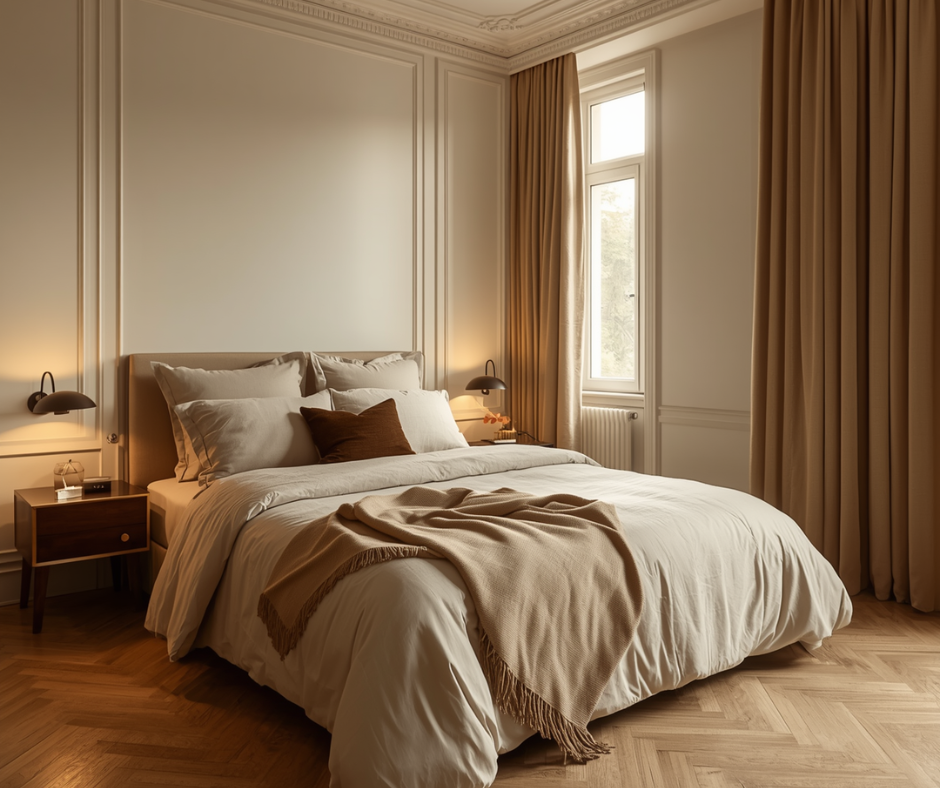
Quiet luxury is wealth that doesn’t advertise. No logos, no obvious expense, no trending colours that will date the room in six months. Quality materials in neutral tones that look effortless because the effort was in editing, not accumulating.
In interiors: natural materials, tonal colours, excellent construction, you feel rather than see, and the complete absence of things that say “look at me.”
The principle translates to small bedrooms on normal budgets if you understand the core rule: quiet luxury is not expensive. It is the absence of things that announce themselves.
In small bedrooms specifically: The aesthetic requires restraint, visible negative space, and materials you can identify by touch. Small rooms provide the spatial constraints that force this discipline. Large rooms let you get away with more. Small rooms require editing from the start.
Why Small Rooms Work for Quiet Luxury (The Reframe)
Small bedrooms force the editing that makes quiet luxury work. You cannot accumulate fifteen neutral decorative objects in 8 square metres without the room feeling cluttered. The spatial constraint does half the aesthetic work for you.
Why this works:
Limited colour palette becomes necessary – Small rooms look larger with monochromatic schemes. Quiet luxury requires tonal neutrals. The design need and the aesthetic align.
Fewer objects appear intentional – In large rooms, minimal styling can look unfinished. In small rooms, minimal styling looks deliberate. Three carefully chosen objects read as curated restraint rather than emptiness.
Quality materials become the only visual interest – Without space for decorative items or pattern, you’re left with texture, material, and light. This is exactly what quiet luxury emphasises. Linen texture, wood grain, ceramic glaze—material quality becomes the design.
The key to keeping it interesting: You might find quiet luxury boring. Fair. Here’s how you make it work—have fun with textures and materials. Or maybe the structure. Or a dash of accent colour. The restraint is in pattern and announcement, not in tactile variety or subtle colour depth.
The Quiet Luxury Colour Palette for Small Bedrooms
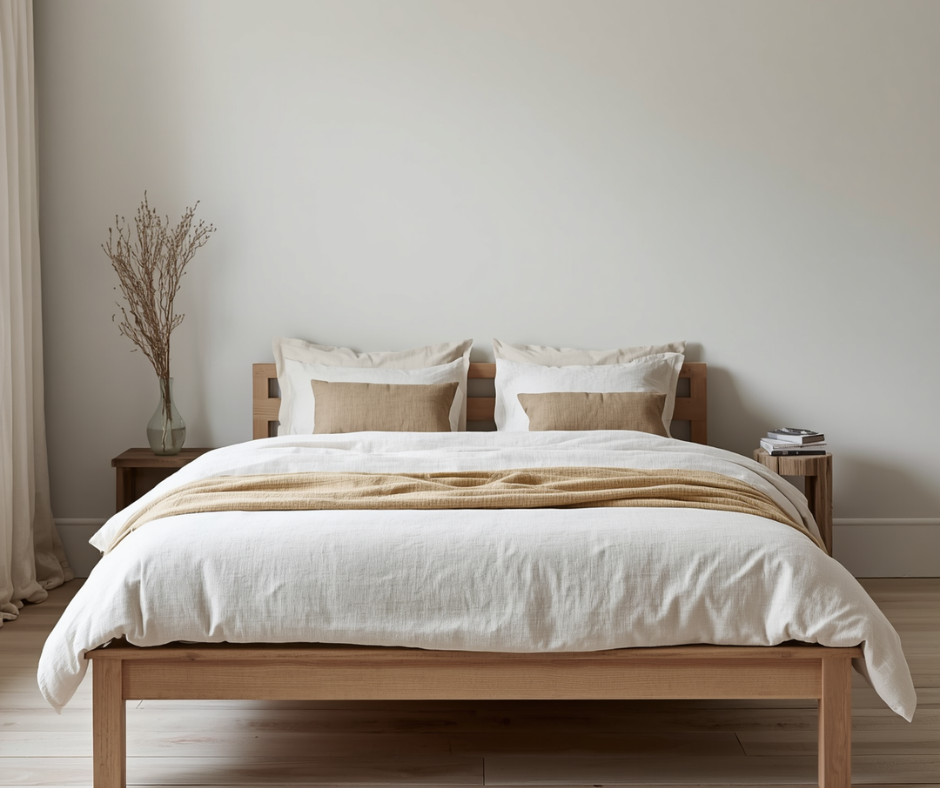
Quiet luxury in small bedrooms uses 2-3 colours maximum, all from the warm neutral family.
Primary colour (60-70%): Warm white, cream, or pale greige. Walls, larger textiles, and main furniture. Not stark white (too cold, too hotel), not grey (reads Scandinavian rather than quiet luxury).
About bright white: People love using bright white for quiet luxury. It looks nice in hotel rooms. But we’re not washing duvets daily as hotels do. Your hands are dirty. They will stain beautiful white cushion covers. Plus, bright white looks too cold for bedrooms where you’re actually trying to sleep and feel comfortable.
Secondary colour (20-30%): Light warm wood or stone/oat/linen tones. Bed frame, smaller textiles, accessories.
Accent (10% maximum): Deeper neutral in the same warm family. Warm taupe, soft camel, muted mushroom. One throw, one pillow, possibly one ceramic object. Or—if you’re brave—a whisper of sage, dusty rose, or warm terracotta. Still muted, still tonal, just not beige.
Temperature consistency matters: Mixing warm and cool neutrals destroys tonal harmony. Cream walls with grey bedding, or beige textiles with cool white furniture—the temperature clash makes quiet luxury fail. Choose warm or cool and commit entirely.
For more on colour in small bedrooms, see my analysis of the best colours for small bedrooms, where I discuss how different palettes affect perceived space.
Texture Over Pattern: The Non-Negotiable Rule
The rule: In small, quiet luxury bedrooms, texture creates visual interest. Pattern creates visual noise.
Never use typography or geometry patterns. Ever. Even neutral geometric prints read as busy in small spaces. Patterned bedding, printed curtains—all of these fragment the visual unity.
Textured materials in tonal colours provide depth without breaking the calm.
Textures that work:
Linen – The essential quiet luxury textile. Visible weave, natural wrinkles, feels expensive without looking fussy.
Here’s the honest part: Make sure you spend money on good-quality bedding and textiles for quiet luxury. Maybe they won’t show in pictures, but honey, you can feel them. Your sensory experience matters more than photos. You don’t want to scratch yourself out of cheap duvets or wake up covered in lint from dusty, matted rugs.
A quality linen duvet cover in oat, stone, or warm white is the foundation. Natural wrinkles are intentional—this is not corporate, hotel-crisp. 👉 Check linen duvet covers on Amazon (affiliate link—adding soon)
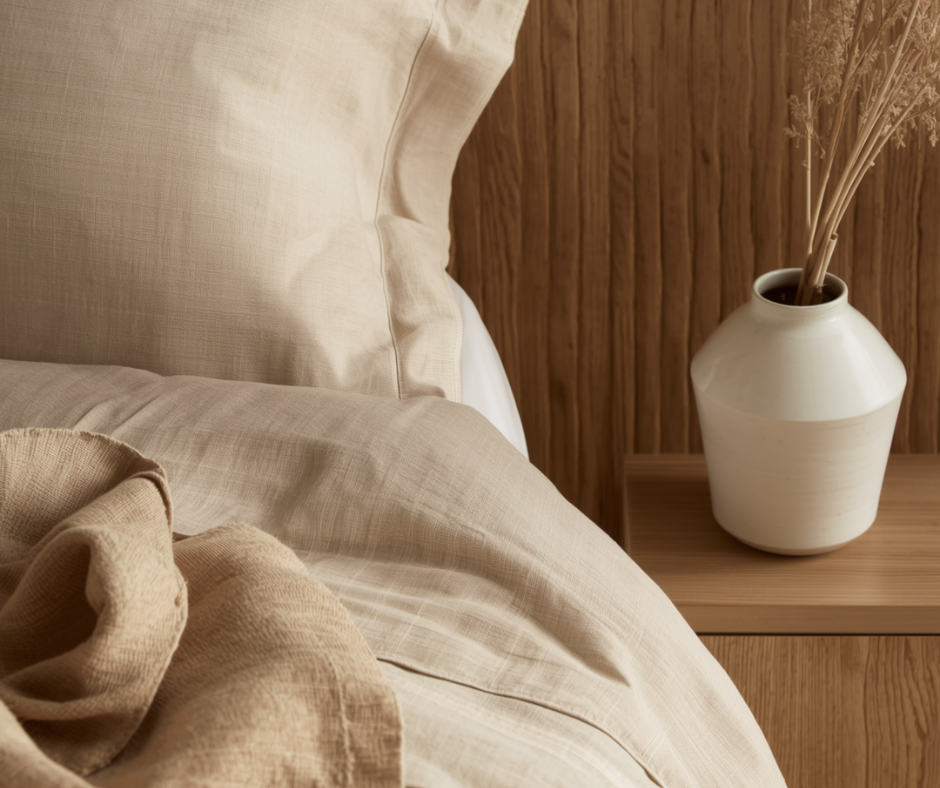
Bouclé or waffle weave – Adds three-dimensional texture whilst maintaining tonal neutrality. Use for throws or pillow covers.
A textured throw in bouclé or waffle weave provides warmth and tactile interest. Choose stone, oat, or cream. 👉 Check bouclé throws on Amazon (affiliate link—adding soon)
Natural wood grain – Visible grain in light woods (oak, ash) adds organic variation. Bed frames, side tables, shelving.
Ceramic with visible glaze – Handmade-looking rather than perfectly smooth. Glaze variations add interest without new colours.
What to avoid:
High-gloss finishes – Lacquered furniture, shiny metallics, glossy ceramics reflect light too sharply. Quiet luxury favours matte and semi-matte finishes.
Faux materials – My distaste for faux materials is beyond measure. Fake leather, synthetic “linen”, printed “wood grain.” Your eye knows they’re not real, and the dissonance breaks the calm aesthetic.
However: I do use faux materials for budget guest bedrooms. Guests usually don’t care how much products cost—they just want them to be usable and pretty. But for your own bedroom, where you’re trying to achieve actual quiet luxury? Invest in genuine materials. Better one real cotton item than three polyester ones claiming to be linen-blend.
What to Remove to Achieve Quiet Luxury
Quiet luxury in small bedrooms is created by removal, not addition.
What needs to go:
All patterned items – Printed pillows, patterned rugs, decorative artwork with busy designs. If it has a pattern, it announces itself.
Decorative objects serving no function – The aesthetic bowl that holds nothing, staged books you’ll never read, candles you never light. If you don’t use it, it’s clutter in expensive packaging.
Anything in a trending colour – That year’s “it” colour, brass that will date the room. Quiet luxury stays neutral because neutrals don’t age.
Multiple small items – Seven throws, four decorative pillows, three candles, five ceramic objects. Consolidate to: one throw, two pillows, one candle, one bowl. The room immediately feels more expensive.
Visible storage containers – Even natural woven baskets create visual clutter when you have six of them. Move everything into the closed wardrobe storage.
The difference: Before removal, rooms feel like they’re trying to be luxurious. After removal, they just are. The effort becomes invisible.
The Objects That Create Quiet Luxury in a Small Room
The Suinny Quiet Luxury Test: Before buying anything, ask: “Will I remember buying this in six months?” If yes, it’s announcing itself. If no—if it blends so seamlessly you forget its origin—it passes.
Objects worth having:
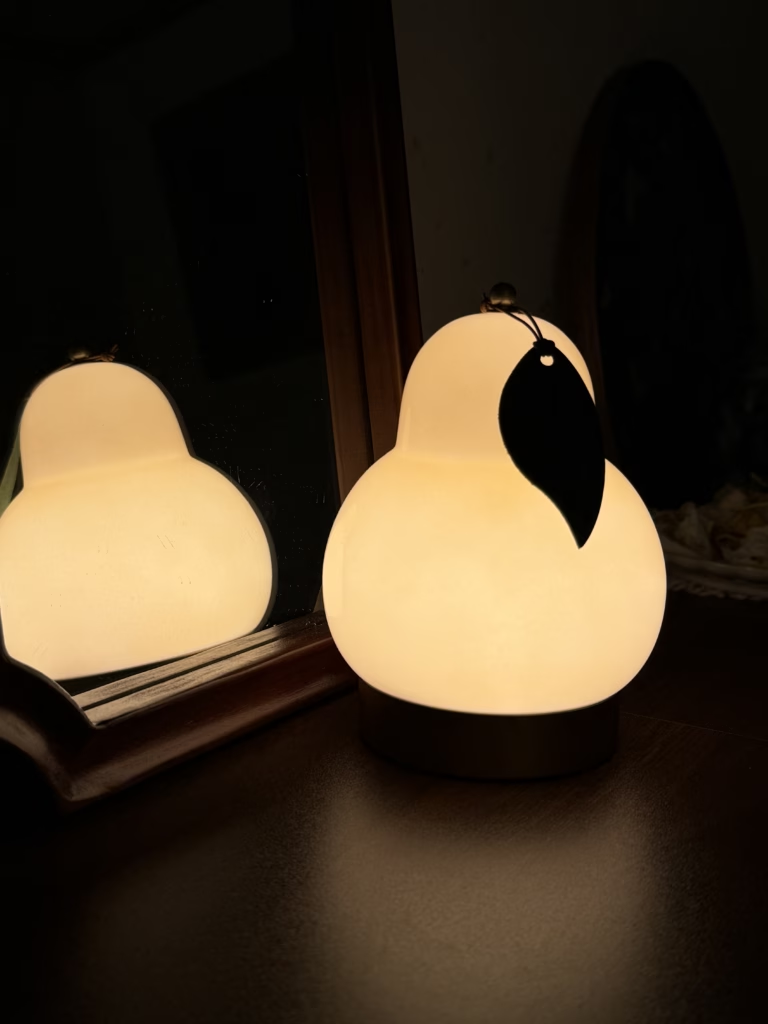
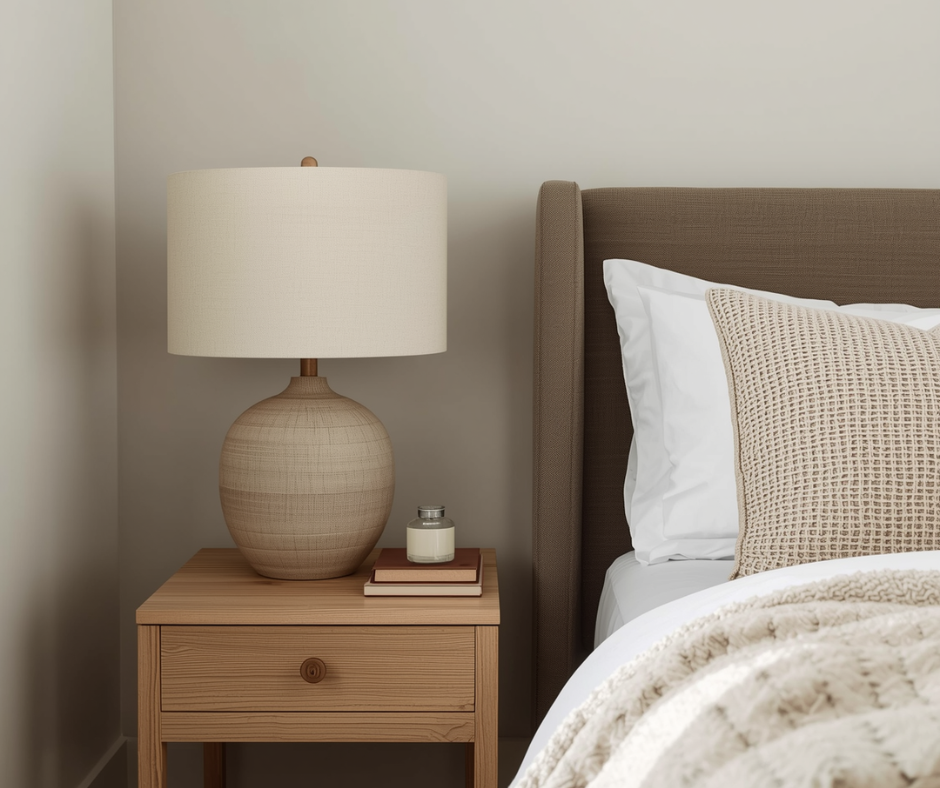
One large ceramic lamp with a linen shade
Creates ambient light for better bedroom sleep whilst adding material quality through visible ceramic texture and natural linen shade. Simple shapes only—cylinder or oval base, drum shade.
Large ceramic lamps in cream or warm white with linen shades provide soft light without decorative fuss. 👉 Check ceramic table lamps on Amazon (affiliate link—adding soon)
Warning: “Ceramic-look” resin or painted metal defeats the purpose. Genuine ceramic or skip it.
Quality pillow covers in tonal colours
Two maximum. One in the base neutral (cream linen), one in the deeper accent (taupe or stone). Different textures, same colour family.
This is where you spend money. Feel the fabric before buying if possible. Linen or linen-cotton blend in stone or oat. 👉 Check linen pillow covers on Amazon (affiliate link—adding soon)
One unscented or subtly scented candle in a simple vessel
Glass, ceramic, or stone container with minimal branding. Cream or white wax. If scented, choose something that smells expensive without being identifiable—fig, sandalwood, “white tea.”
Simple candles in neutral vessels become functional objects that happen to look good. 👉 Check minimalist candles on Amazon (affiliate link—adding soon)
Natural material objects with a clear function
Wooden tray for daily items. Ceramic bowl for jewellery. Linen storage box. Each must serve a purpose whilst looking quietly beautiful.
What not to buy:
Typography or geometric patterns – Never. These announce themselves.
Matching bedroom sets – Deliberately coordinated furniture looks staged. Mix pieces that share colour family and material quality but aren’t obviously “a set.”
“Statement pieces” – If it makes a statement, it’s not quiet luxury.
Multiple throw pillows – Two maximum. Six pillows in tonal neutrals are still visual clutter, just in beige.
What Quiet Luxury Is NOT in a Small Bedroom
Not everything in beige
Neutrals require variation in tone, texture, and material. Cream linen, oat bouclé, light oak, warm ceramic—these are different whilst remaining neutral.
Not minimalism with expensive labels
A designer handbag on your bedside table is a luxury that announces itself. The whole point is the absence of announcement.
Not the same as Japandi or Scandinavian minimal
Japandi has more texture contrast. Scandinavian includes cooler tones. Quiet luxury is warmer, softer, more tonal. These aesthetics overlap but aren’t identical.
For contrast, see my navy blue bedroom with orange accents post—maximalist colour that works in small rooms but exists on the opposite end of the spectrum.
Not achievable with clutter
Even neutral clutter is clutter. The aesthetic requires everything to have a place and be invisible when not in use. If you’re not ready for that maintenance level, choose a different style.
Not cold or sterile
If your room feels like a dentist’s waiting room, you’ve gone too far toward white. Add warmer tones, more linen, and visible wood grain.
The Small Room Advantage
What makes quiet luxury easier in small bedrooms:
Spatial constraints enforce editing – You can’t accumulate clutter because there’s no space. The constraint does half the work.
Quality materials cost less in small spaces – A linen duvet for a double bed costs less than a king. One large lamp serves the whole room. Small footprint makes genuine materials more affordable.
Fewer objects carry more visual weight – That one ceramic lamp, single bouclé throw, pair of linen pillows—they become the entire aesthetic because nothing else competes for attention.
What I’d Actually Do
If I were designing a quiet luxury bedroom in a small space today:
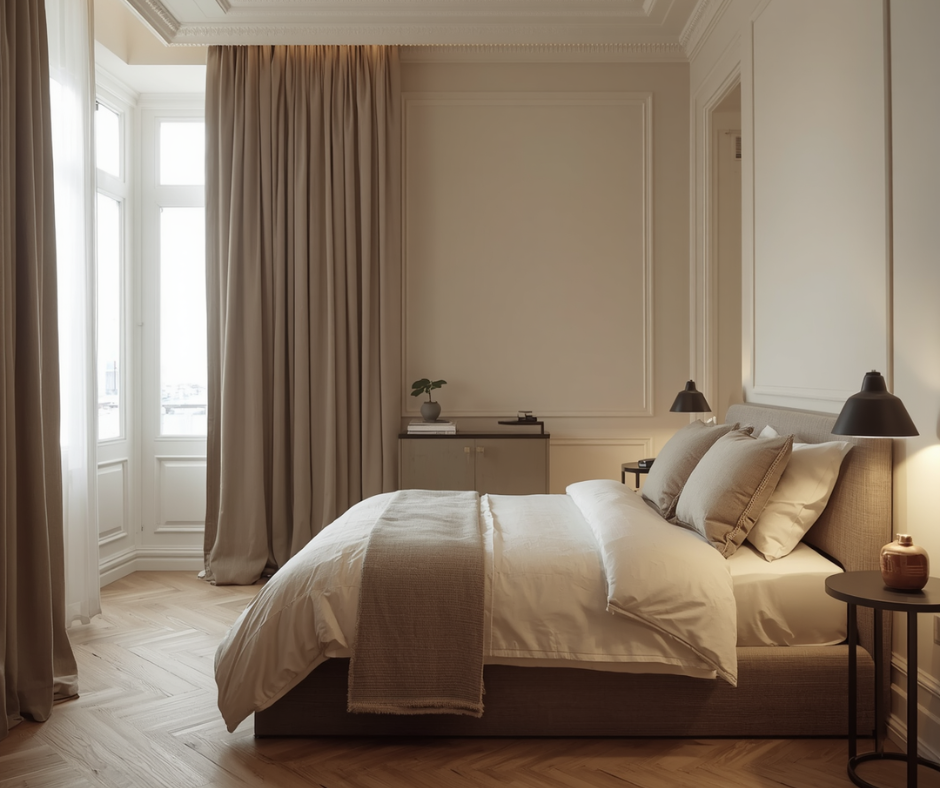
Base: Warm cream walls, light oak platform bed, oat linen duvet cover (quality, not cheap)
Texture: One bouclé throw in stone, two linen pillow covers (one cream, one taupe)
Function: One large ceramic lamp, a wooden tray for daily items, a ceramic bowl
Accent: Maybe a whisper of sage in one small object. Maybe not. Depends on the day.
Total objects beyond furniture: Six. That’s it.
What I wouldn’t do: Bright white anything (too cold, shows stains), faux materials for my own use (guests yes, me no), patterns of any kind, multiple decorative items.
Would this be boring? Possibly. Would it look expensive whilst costing less than a colourful maximalist room? Absolutely. Would you be able to feel the quality of the materials even if the photos don’t show it? That’s the entire point.
Your Next Step
Walk into your bedroom. Identify every item that announces itself—patterned textiles, decorative objects, trending colours, visible branding.
Remove one. The most obvious offender.
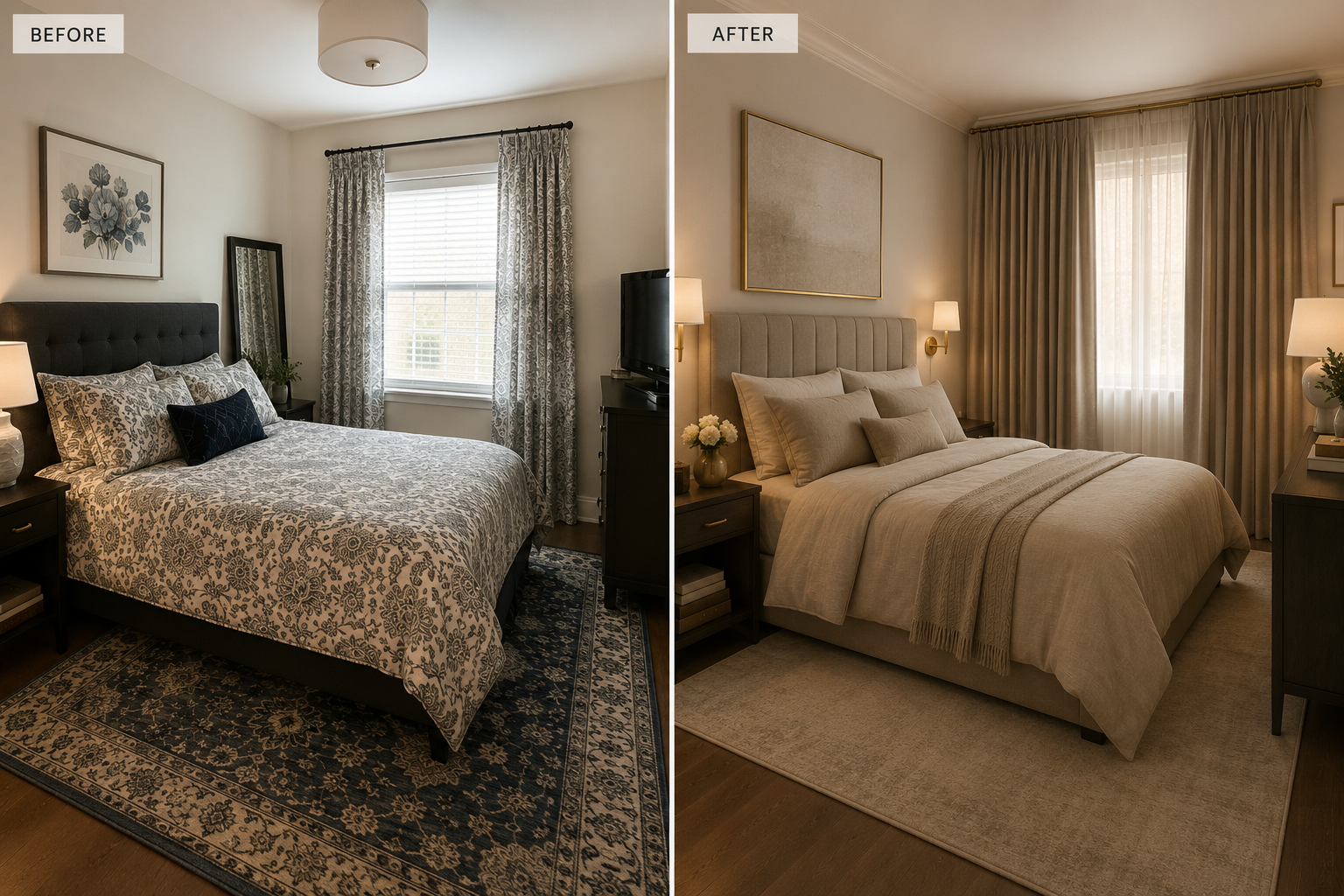
See what happens. Notice whether the space feels calmer, larger, or more cohesive.
Quiet luxury in small bedrooms isn’t built by buying the right neutral duvet cover. It’s built by removing the seven things competing with that duvet cover for attention.
Start with removal. Then—only then—consider adding one quality-neutral object if you genuinely need it. Something you can feel the quality of. Something that won’t announce itself.
The room won’t feel quietly luxurious because you bought expensive things. It’ll feel quietly luxurious because nothing is demanding you notice it—except maybe the fact that your duvet cover is genuinely, tactilely, expensive-feeling linen instead of scratchy polyester claiming to be linen-blend.
Now go remove something that’s been announcing itself.
Suinny Everyday is a participant in the Amazon Services LLC Associates Program, an affiliate advertising program. As an Amazon Associate, I earn from qualifying purchases at no extra cost to you.