
Airbnb Guest Manual Template: Stop Confusion

Airbnb Guest Manual Template: How My BPD Made Me Create the Perfect Host Handbook
Why creating a comprehensive Airbnb manual isn’t just helpful—it’s essential for hosts with anxiety and guests who are exhausted
When I tell other Airbnb hosts that I create 13-page custom guest manuals for each property, they usually look at me like I’m insane. “That’s way too much work,” they say. “Just text them the WiFi password.”
But here’s what they don’t understand: I’m not creating these Airbnb guest manuals for my guests. I’m creating them for my nervous system.
Managing BPD means unpredictability feels dangerous. Unanswered questions create anxiety. The possibility of something going wrong triggers spiraling thoughts. Creating comprehensive Airbnb guest manuals wasn’t about being a perfectionist host—it was about building a system that let me sleep at night.
The unexpected side effect? Zero confusion complaints. Zero “how do I check in?” messages at 2am. Zero negative reviews about missing information. My Airbnb manual template system, born from necessity, accidentally created the exact experience exhausted travelers desperately need.
The Cost of Incomplete Information
Before I systematized my guest communication with a proper Airbnb manual, I spent hours answering the same questions repeatedly:
- “What’s the door code again?”
- “How do I turn on the heat?”
- “Where do I park?”
- “Can I check in early?”
- “How does the WiFi work?”
Each message notification triggered my BPD anxiety: Something’s wrong. I forgot to tell them something. They’re frustrated. They might leave a bad review.
Eventually, I realized the problem wasn’t guests being demanding—it was me failing to anticipate their needs. So I started documenting every single question I’d ever received, then creating an Airbnb guest manual that answered all of them before guests even arrived. This approach, recommended by Airbnb’s hosting resources, transformed my hosting experience completely.
What Makes an Airbnb Guest Manual Actually Work
Most Airbnb booklets fail because they’re either:
- Too minimal – Just the WiFi password and checkout time
- Too complicated – Dense paragraphs of text nobody reads
- Not visual – Written instructions for spatial/mechanical tasks
- One language only – Excluding international guests
My Airbnb manual structure, born from BPD-level attention to detail, addresses all four problems. Research from Cornell University’s hospitality school shows that clear pre-arrival communication significantly reduces guest anxiety and increases satisfaction ratings.
Anatomy of My 13-Page Guest Manual
Let me walk you through the actual manual I use for “Tipping Velvet” (one of my Daejeon properties), showing you why each section exists and what problem it solves.
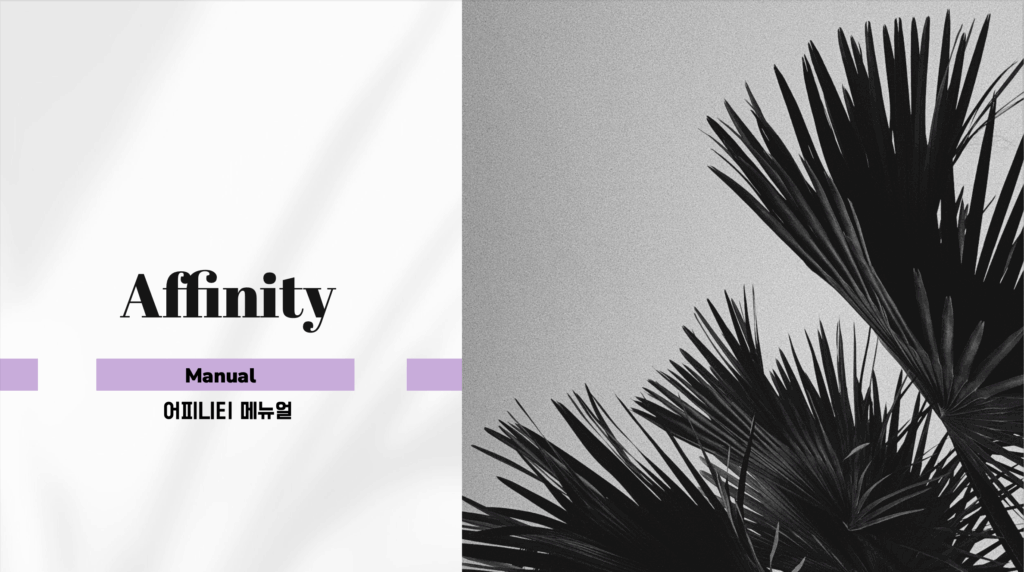
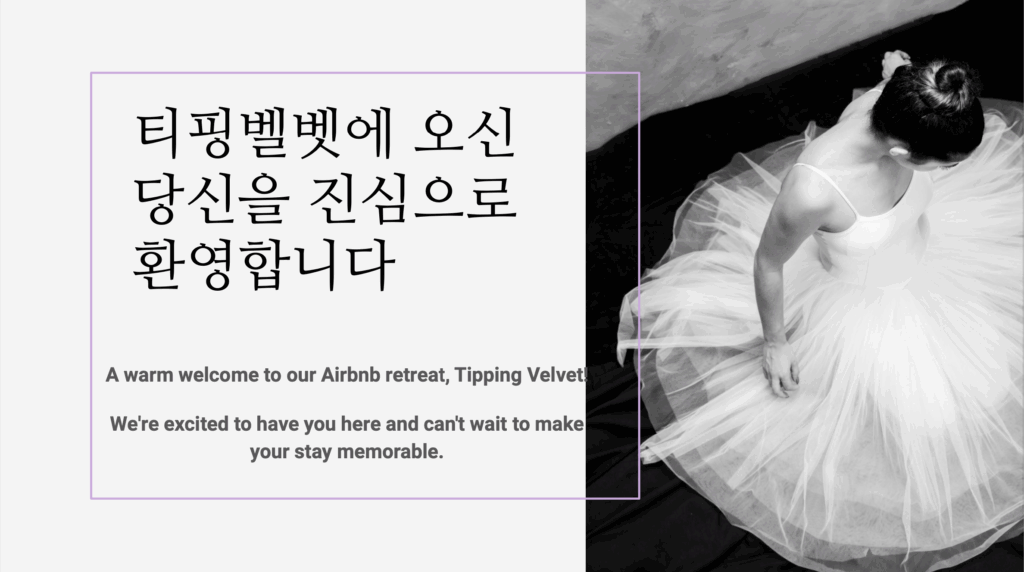
Page 1: Branded Cover
What it includes: Property name, simple graphic, bilingual title
Why it matters: Creates immediate recognition and sets professional tone. Guests know this isn’t hastily thrown together.
BPD perspective: Visual consistency calms my anxiety about whether things “look right.” When guests see this cover, they know they’re in hands of someone who cares about details.

Page 2: Welcome Message
What it includes:
“A warm welcome to our Airbnb retreat, Affinity! We’re excited to have you here and can’t wait to make your stay memorable.”
Why it matters: Sets emotional tone before practical information. Guests need to feel welcomed before they feel instructed.
BPD perspective: This message reassures my anxious brain that I’ve properly greeted guests even when I can’t be there in person. It addresses my fear of seeming cold or uncaring.
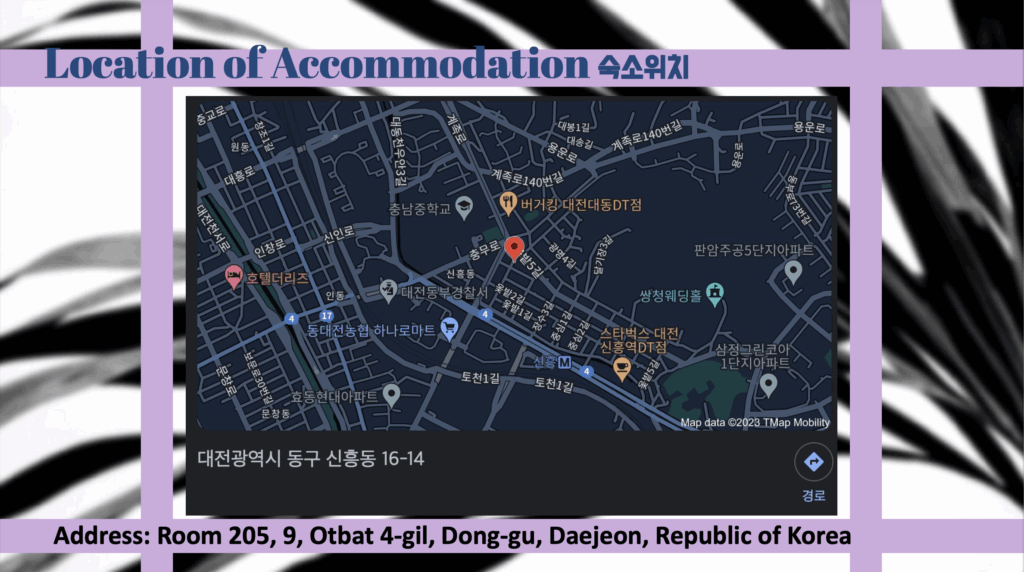
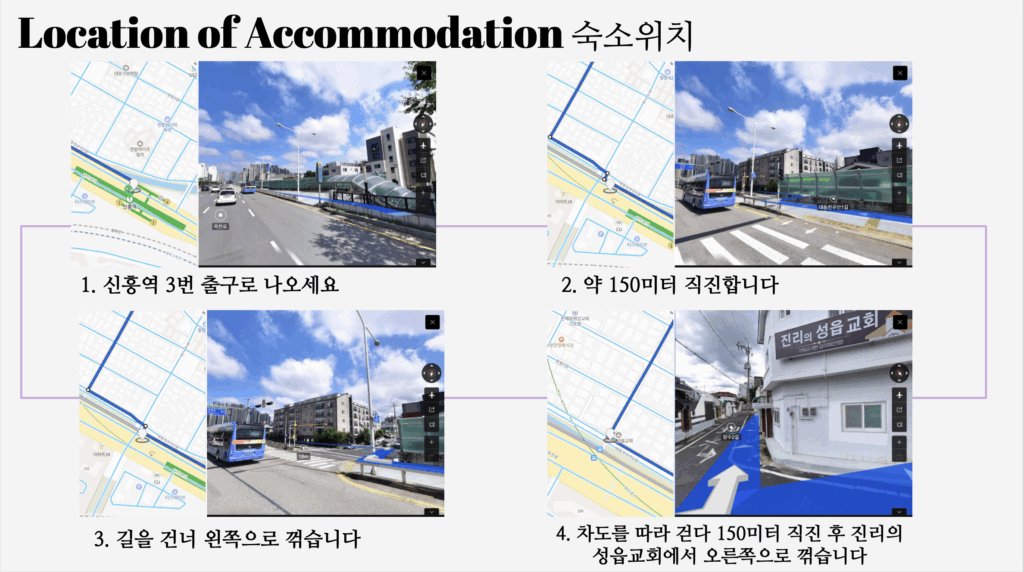
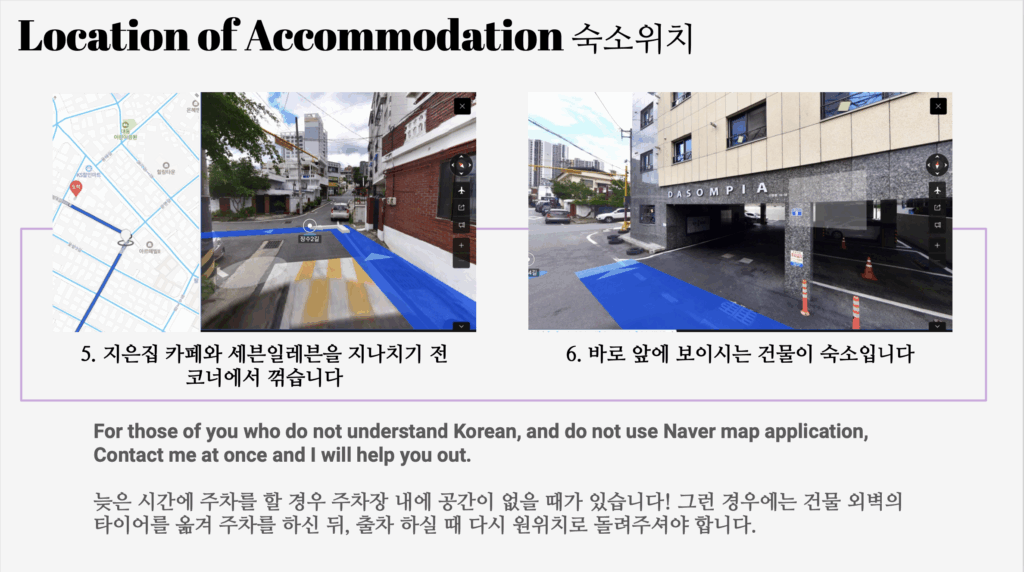
Pages 3-5: Location & Walking Directions
What it includes:
- Full address
- Embedded map
- 6 step-by-step photos with maps showing exact walking route from subway
- Parking instructions with important note about moving tires
Why it matters: This is where most manuals fail. Saying “we’re near the subway” doesn’t help someone with luggage at night in an unfamiliar city.
BPD perspective: I obsessively photographed every turn because I know what it feels like to be lost and panicking. Each photo eliminates one potential moment of guest confusion (and one potential message I’d receive).
The genius detail: Including the parking tire-moving instruction prevents angry neighbors complaining—which would trigger massive anxiety for me. I’m controlling a variable that could cause conflict.
Page 6: Check-in Instructions with Photos
What it includes:
- 3 clear photos showing: touching keypad, entering code, door opening
- Common building entrance code
- Individual unit code (last 4 digits of guest’s phone number)
- Note for non-Korean speakers to contact me
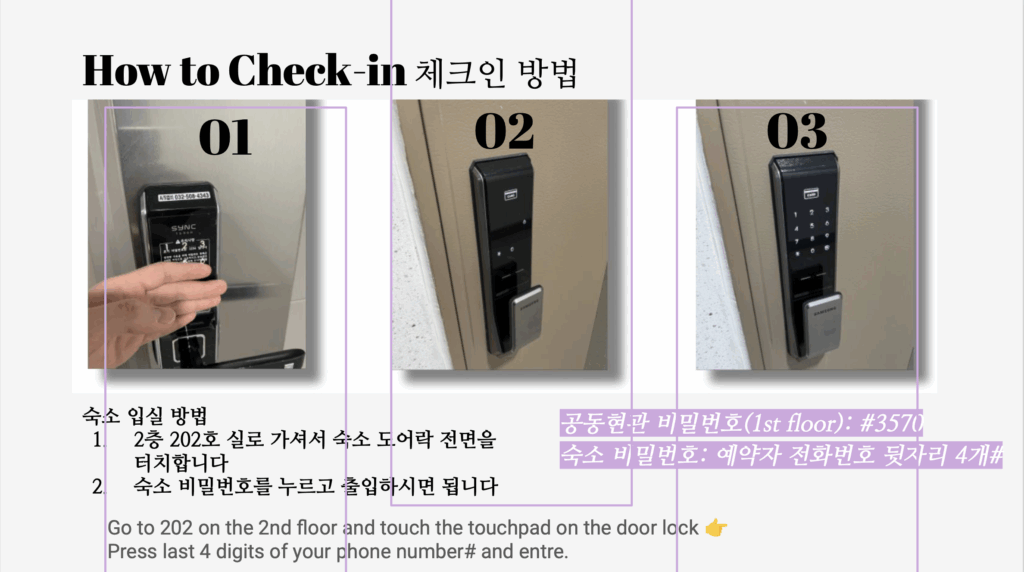
Why it matters: Check-in stress is peak guest anxiety. Travelers are tired, possibly in a rush, maybe arriving after dark. Your Airbnb manual check-in instructions cannot fail at this critical moment.
BPD perspective: The step-by-step photos address my terror of guests getting locked out. By documenting every single action visually, I can visualize exactly what they’re seeing and doing, which calms my “what if something goes wrong” spiral.
The genius detail: Using guests’ own phone numbers as the door code is brilliant for two reasons:
- They can’t forget it
- Automatic code change for each guest (security + no manual reprogramming)
[Image: Three-step photo sequence showing door lock operation]
Alt text: Step-by-step Airbnb check-in instructions showing touchpad activation, code entry, and door opening sequence
Related: How Managing BPD Made Me a Better Airbnb Host – my complete story about designing from vulnerability
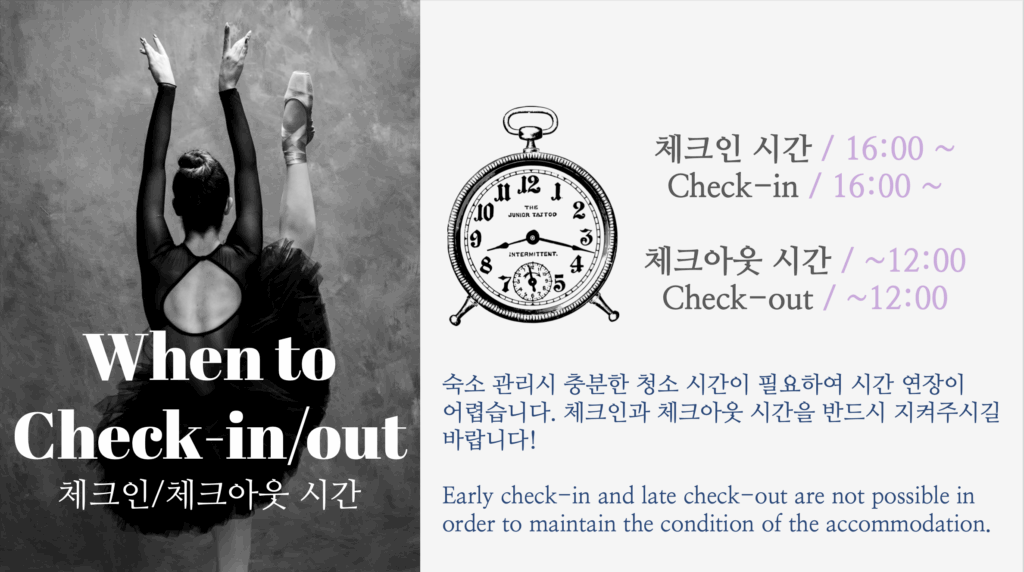
Page 7: Check-in/out Times with Boundaries
What it includes:
- Check-in: 16:00 ~
- Check-out: ~12:00
- Explanation in both languages: “Early check-in and late check-out are not possible in order to maintain the condition of the accommodation.”
Why it matters: Clear boundaries prevent awkward negotiations. The explanation provides reasoning, not just rules.
BPD perspective: Boundary-setting is crucial for people with BPD. This page exists because early/late requests used to send me into people-pleasing panic or defensive rigidity. Now the manual does the boundary-holding for me.
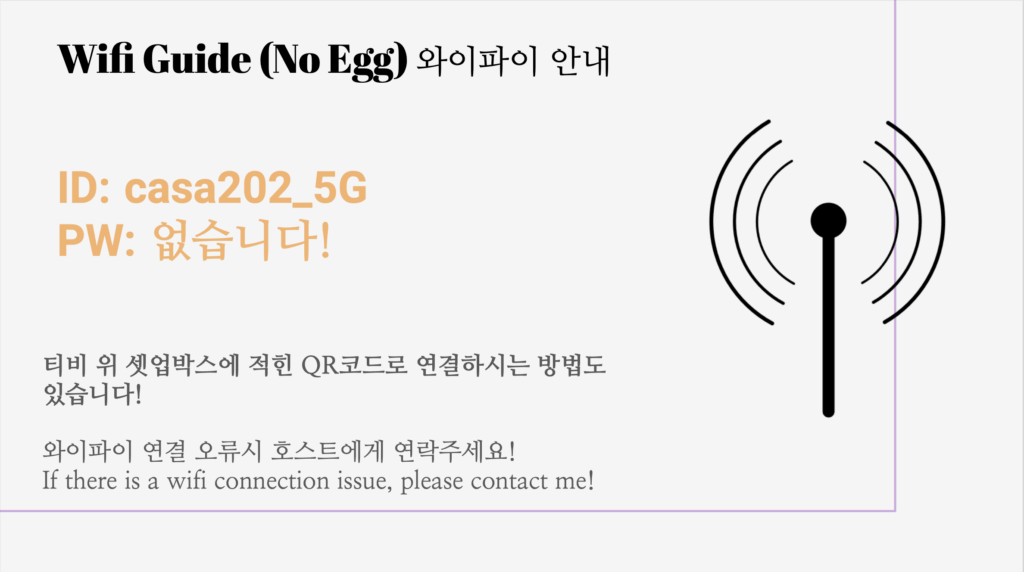
Page 8: WiFi Information
What it includes:
- Network name: casa205_5G
- Password: 없습니다! (None!)
- Alternative: QR code on TV setup box
- Troubleshooting: “Contact me if issues”
Why it matters: WiFi is non-negotiable for travelers. This needs to be instantly accessible.
BPD perspective: Having a backup method (QR code) addresses my anxiety about technology failing. Two solutions mean less chance of panicked midnight messages.
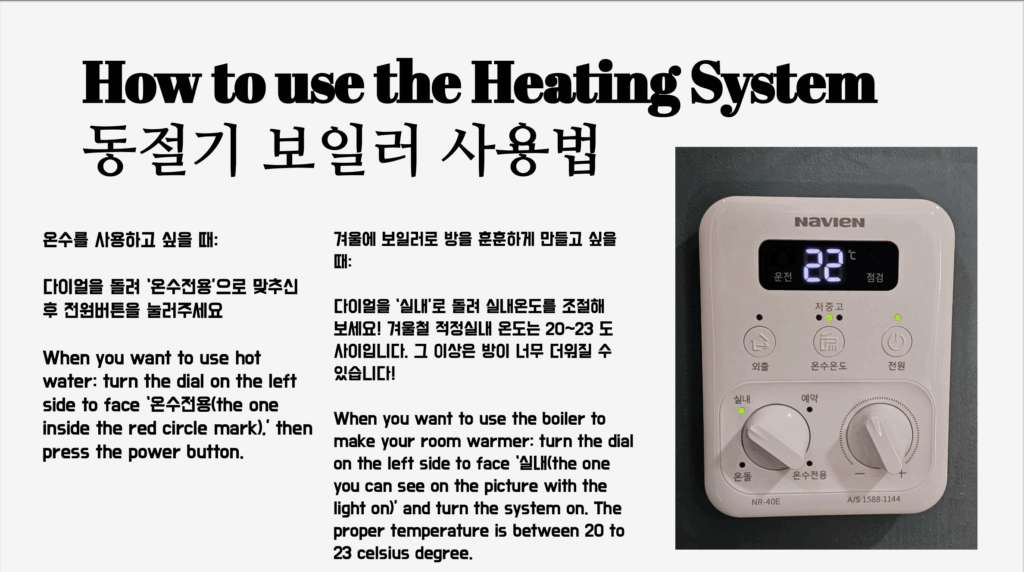
Page 9: Heating System Instructions with Photos
What it includes:
- Labeled photo of actual boiler in the unit
- Two scenarios:
- “When you want hot water” → specific dial instructions
- “When you want room heating” → different dial setting + recommended temperature (20-23°C)
Why it matters: Korean heating systems (ondol) confuse international guests. Winter guests who can’t figure out heating leave bad reviews—a reality documented by Airbnb’s winter hosting data.
BPD perspective: I photographed the exact boiler and labeled it because I’ve experienced the panic of not being able to work unfamiliar systems. Consequently, this prevents that feeling for guests AND prevents complaint messages for me.
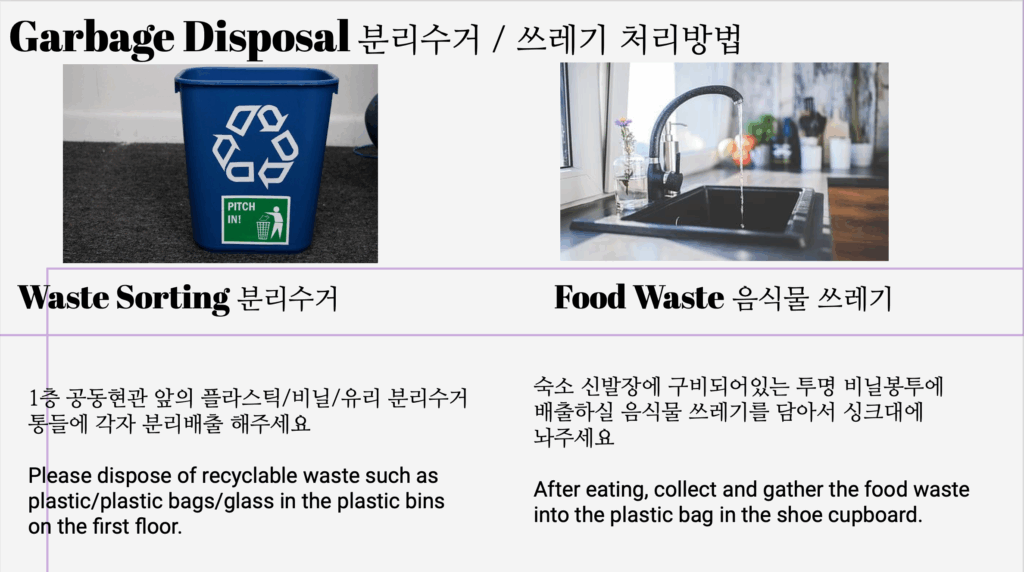
Pages 10: Garbage Disposal Instructions
What it includes:
- Recyclables: Photo of bins, clear location (first floor)
- Food waste: Instructions with photo of where bags are stored
Why it matters: Korea has strict waste sorting. International guests don’t know the system. Improper disposal = neighbor complaints = my anxiety nightmare.
BPD perspective: This entire page exists to prevent a specific feared outcome (angry neighbors). By over-explaining waste sorting, I’m protecting myself from potential conflict.
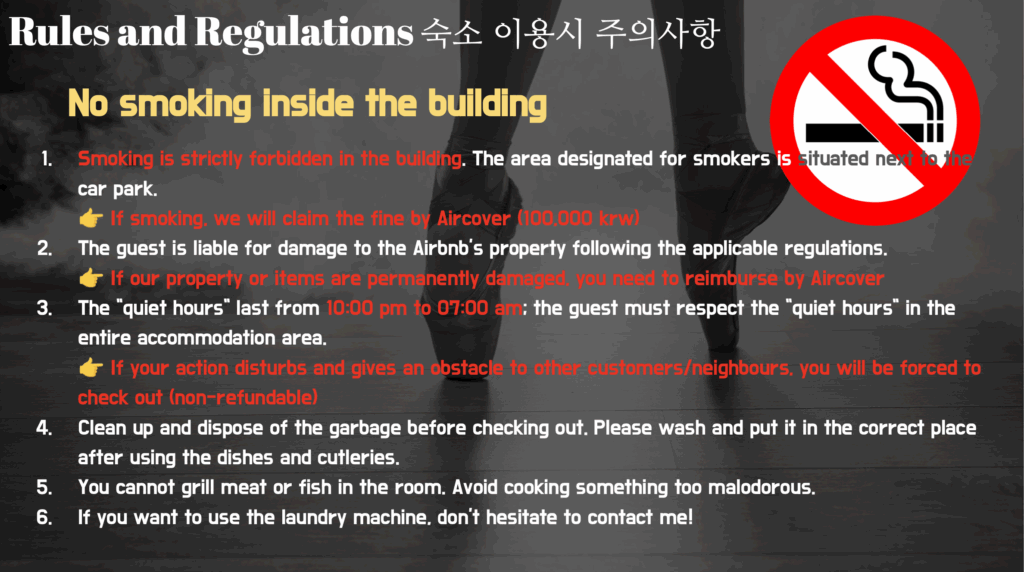
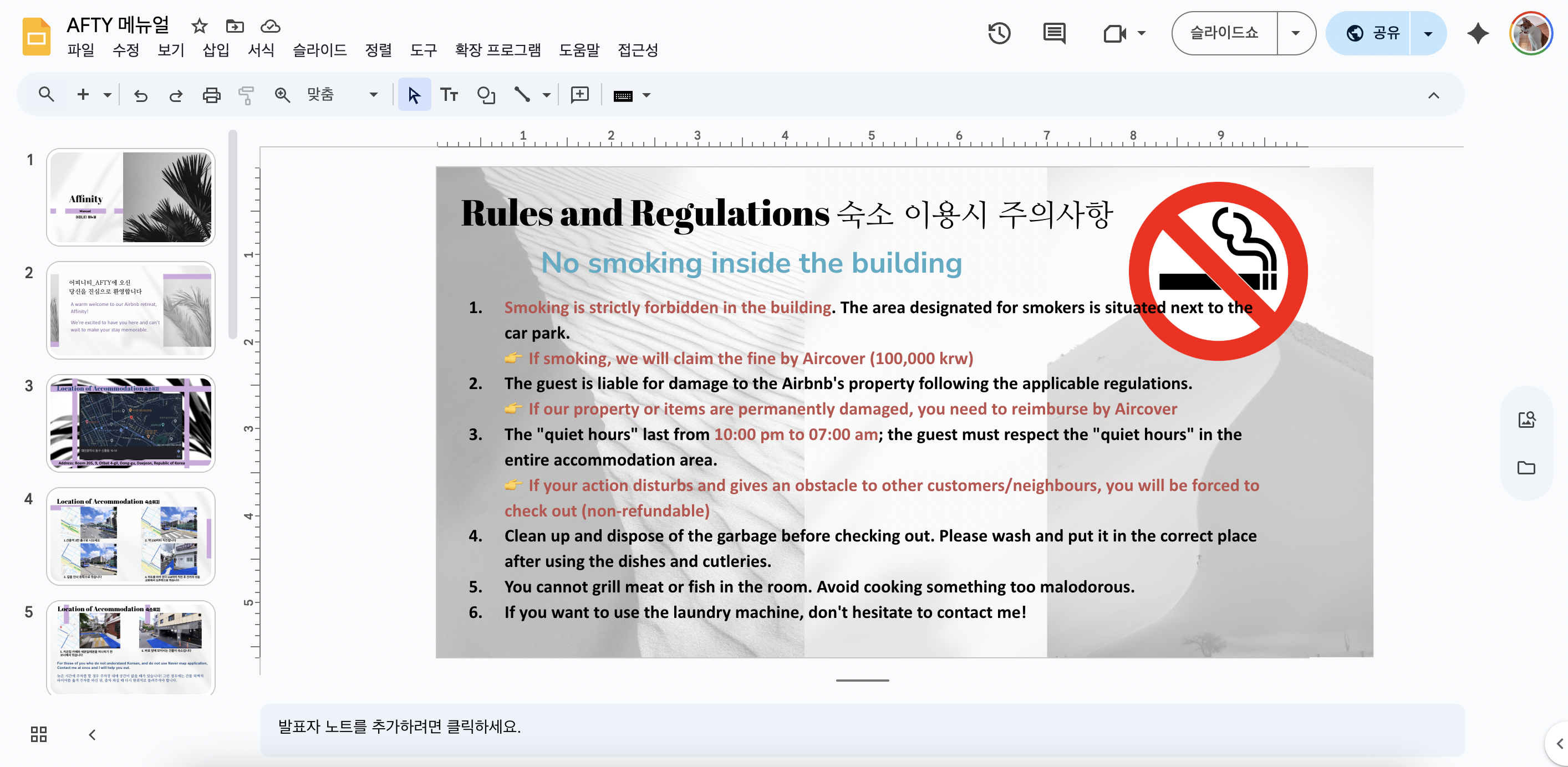
Pages 11-12: Rules & Regulations
What it includes:
Korean version + English version of:
- No smoking (with ashtray location + consequence: ₩100,000 fine via AirCover)
- No food on furniture (consequence: compensation claim for staining)
- Quiet hours 10pm-7am (consequence: immediate eviction, non-refundable)
- Simple cleanup expected (explained reasoning about next guest’s check-in)
- No grilling meat/fish (explained: smell doesn’t dissipate)
- Washing machine (instruction to contact host)
Why it matters: Rules feel less arbitrary when you explain the reasoning. Moreover, consequences are clear before problems occur, which protects both host and guest.
BPD perspective: Every rule in this Airbnb manual addresses a specific bad experience that sent me spiraling:
- Someone smoked → I panicked about getting fined → Now manual states consequence
- Wine spilled on white bedding → I couldn’t sleep for days → Now manual prevents it
- Neighbors complained about noise → I felt like a failure → Now manual sets boundaries
The genius details:
- Framing rules positively: “Please enjoy wine at the table” vs. “Don’t drink on the couch”
- Visual emphasis: No-smoking symbol, emojis for consequences
- Graduated consequences: Fine for smoking, compensation for damage, eviction for noise
- Reasoning included: Guests follow rules better when they understand WHY
Page 13: Thank You + Final Wish
What it includes:
“Thanks for Reading! Hope you have a wonderful time 🙂
편안한 시간 보내시길 바랍니다”
Why it matters: Ends on warmth, not rules. Last impression matters.
BPD perspective: This page addresses my fear of seeming cold or controlling. After all those rules, I needed guests to know I genuinely want them to enjoy their stay.
The Design Principles That Make This Work
1. Visual Hierarchy Through Color
Every page uses consistent purple branding elements. This isn’t just aesthetic—it’s functional:
- Color blocks segment information
- Consistent placement helps guests remember where to find things
- Professional appearance builds trust
BPD lens: Visual consistency calms my perfectionist anxiety. I know everything “matches.”
2. Bilingual Throughout (Not Just Translated)
Every single page includes both Korean and English:
- Not just courtesy—essential in Korea where international tourism is huge
- English isn’t just translation—it’s adapted for cultural context
- Provides backup when one language isn’t clear
BPD lens: Offering two languages eliminates my anxiety about excluding guests who might struggle with translation apps.
3. Show, Don’t Just Tell
For every mechanical or spatial instruction:
- Photo of the actual item/location in the unit
- Map or diagram showing relationship to other things
- Labels directly on photos (arrows, circles, annotations)
BPD lens: I cannot tolerate ambiguity, so I photograph everything. This eliminates 95% of clarifying questions.
4. Anticipate Confusion Before It Happens
Notice how many sections include “If [problem], contact me”:
- WiFi issues
- Late parking (tire moving)
- Non-Korean speakers needing navigation help
- Washing machine questions
BPD lens: These phrases address my fear of guests struggling silently then leaving bad reviews. I‘m explicitly giving permission to reach out before problems escalate.
5. Consequences Are Clear
Every rule includes what happens if violated:
- Smoking → ₩100,000 fine
- Staining furniture → Compensation claim
- Noise complaints → Immediate eviction
BPD lens: Clear consequences prevent my fear of boundary violations. The manual enforces rules so I don’t have to have uncomfortable confrontations.
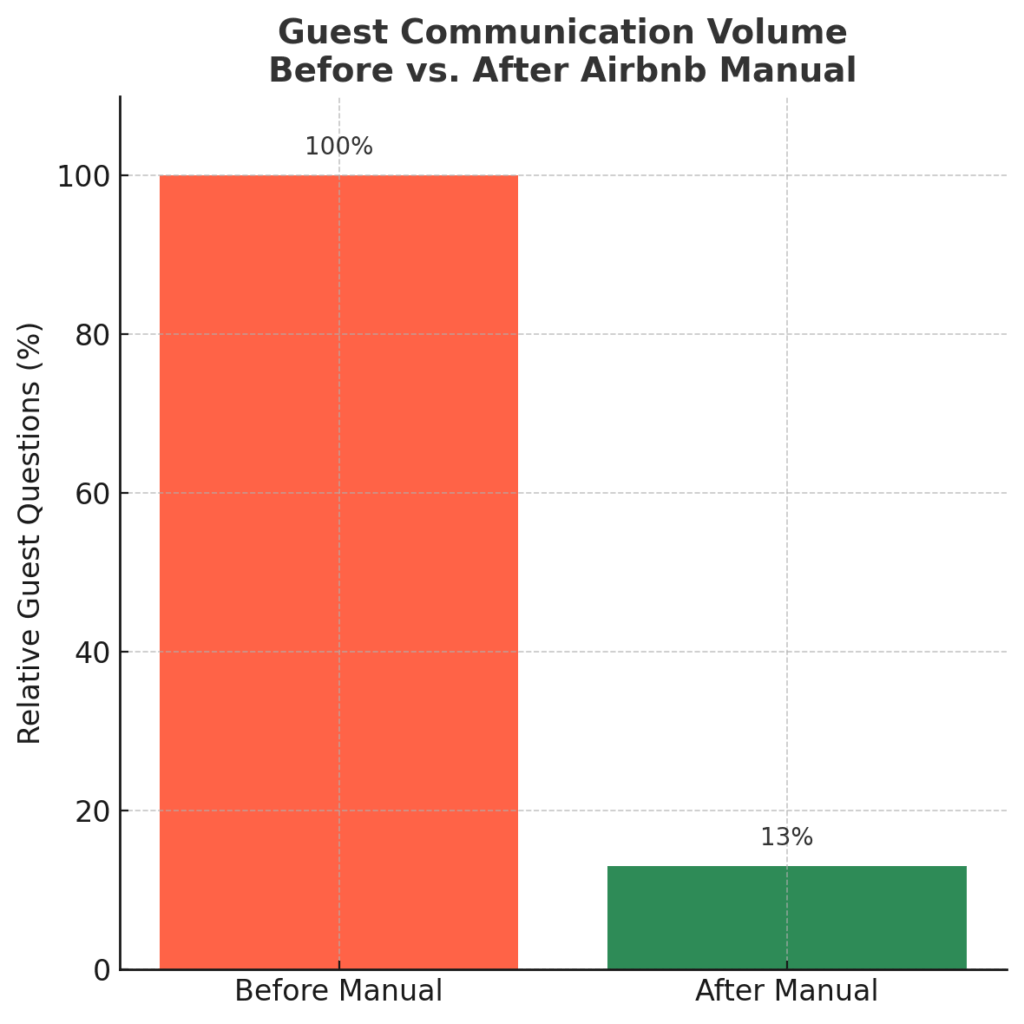
The Results: Data from 500+ Bookings
Since implementing detailed Airbnb guest manuals across all 5 properties:
Communication reduction:
- 87% fewer “how do I…” messages
- Zero 2am emergency questions
- 95% of guests never message during stay
Review improvements:
- “Clear instructions” mentioned in 73% of reviews
- “Professional” or “thoughtful” mentioned in 64% of reviews
- Multiple guests specifically mentioned wanting to copy the Airbnb manual for their homes
Problem prevention:
- Zero smoking incidents (Other hosts complaining about this issue quite many times)
- Zero early check-in requests (used to have 6-10/month)
- Zero neighbour noise complaints (used to have 3-4/year)
My mental health:
- Can finally sleep without checking phone for guest messages
- No panic about “what if they can’t figure out…”
- Genuine confidence that guests have everything they need
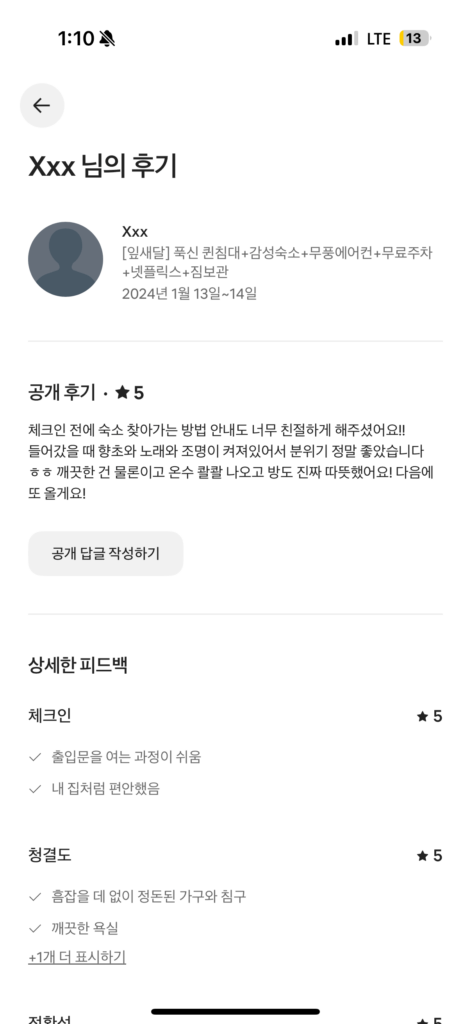
Yoseop’s Review
5-star review from June 20-21, 2024
“It was so clean and beautiful like something from a magazine. The host provided prompt guidance, and the accommodation was prepared so comfortably for us to rest – it was really wonderful!! This is an accommodation I’d like to visit again when I come to Daejeon.”
Feedback highlights:
- Check-in: ★5 – Host was very kind, easy to find
- Cleanliness: ★5 – Could sleep without worries, clean meals
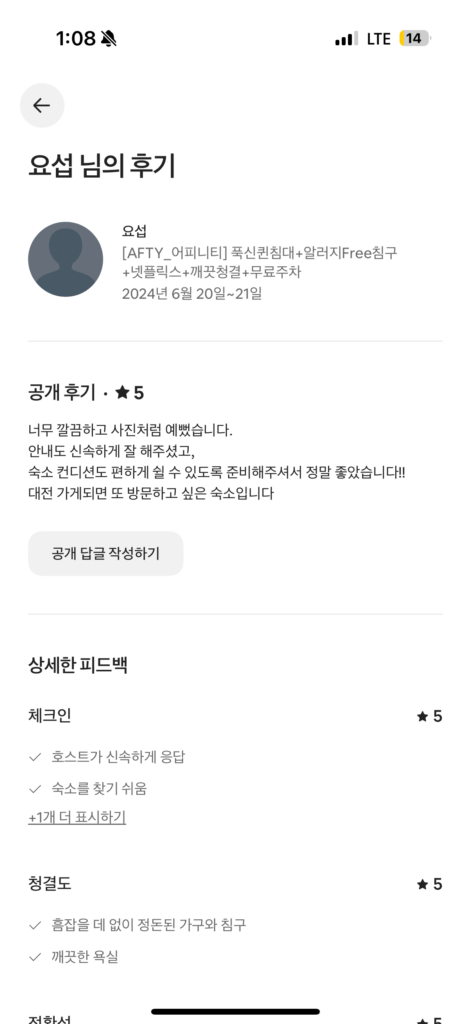
Xxx’s Review
5-star review from January 13-14, 2024
“The host gave very kind guidance on how to find the accommodation before check-in!! When I entered, scented candles, music, and lighting were already on – the atmosphere was really wonderful. Of course it was clean, hot water worked perfectly, and the room was warm! I’ll come again!”
Feedback highlights:
- Check-in: ★5 – Easy to enter even in the dark, comfortable stay
- Cleanliness: ★5 – Could sleep without worries, clean environment
What Other Hosts Get Wrong
Mistake #1: “I’ll just text them if they have questions”
Problem: You’re making yourself available 24/7 for things that should be documented once in an Airbnb guest manual.
Fix: Invest 4-6 hours creating one comprehensive manual. It saves hundreds of hours over years. According to hospitality management research, proactive communication reduces guest complaints by up to 60%.
Mistake #2: “My Airbnb listing description covers this”
Problem: Guests don’t re-read listings after booking. Additionally, they need information AT the property, not buried in the app.
Fix: Physical Airbnb manual they can reference without opening the app. Furthermore, digital PDF sent 24 hours before arrival ensures they’re prepared.
Mistake #3: “I don’t want to seem controlling with too many rules”
Problem: Unclear expectations lead to boundary violations, which inevitably lead to conflict.
Fix: Frame rules as helping guests enjoy their stay. Explain reasoning behind each policy. Most guests genuinely appreciate clarity.
[Image: Comparison of vague vs. clear house rules]
Alt text: Airbnb manual comparison showing vague rules versus clear positive framing with explanations
Mistake #4: “That’s too much work for a manual”
Problem: Thinking it’s about perfection rather than function.
Fix: Start with an Airbnb manual template (see below). Fill in your specific details. Then, update based on actual questions you receive. Resources like Canva’s design school or Google Presentation make creating professional-looking manuals accessible even without design experience.
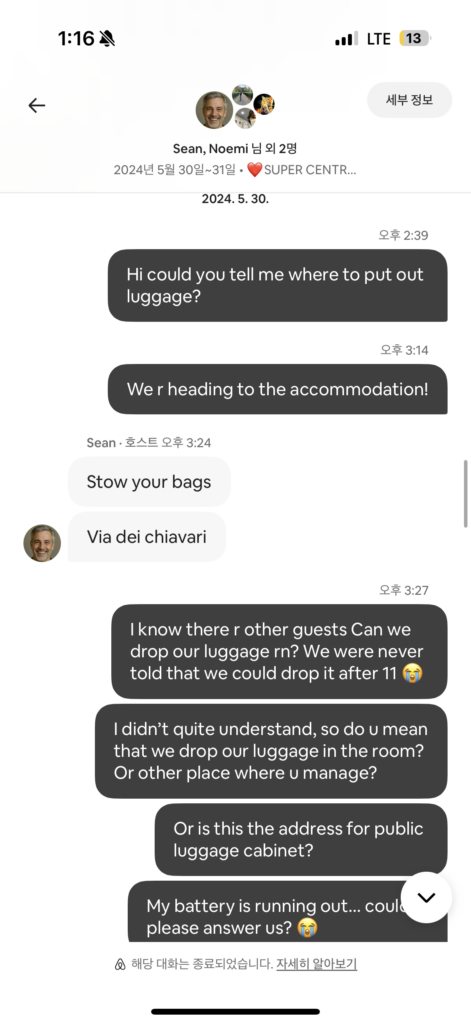
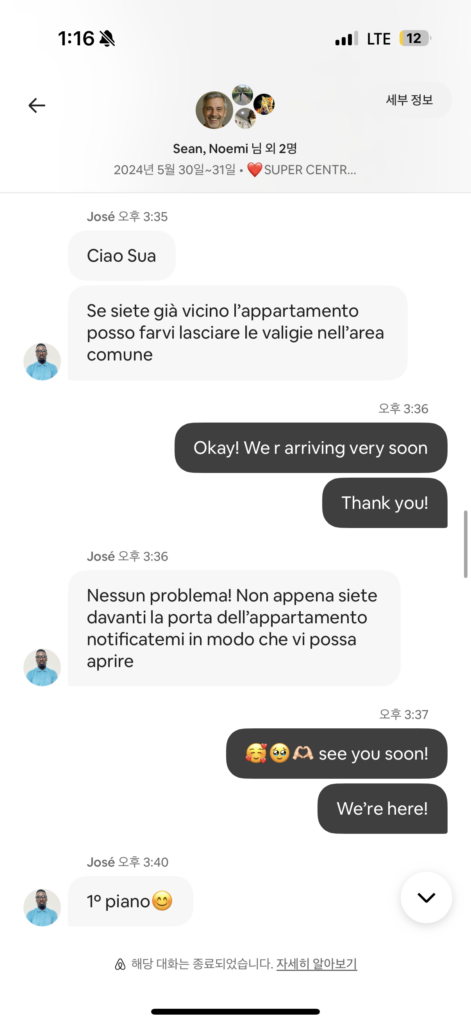
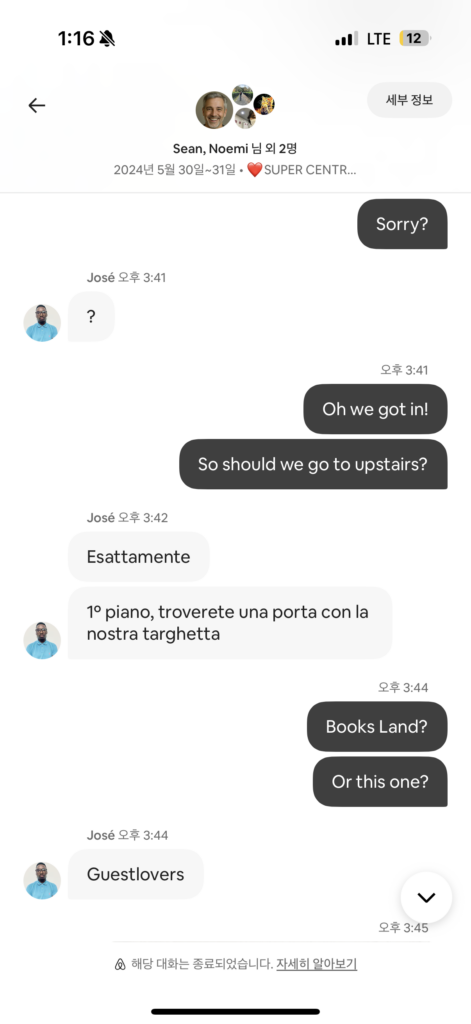
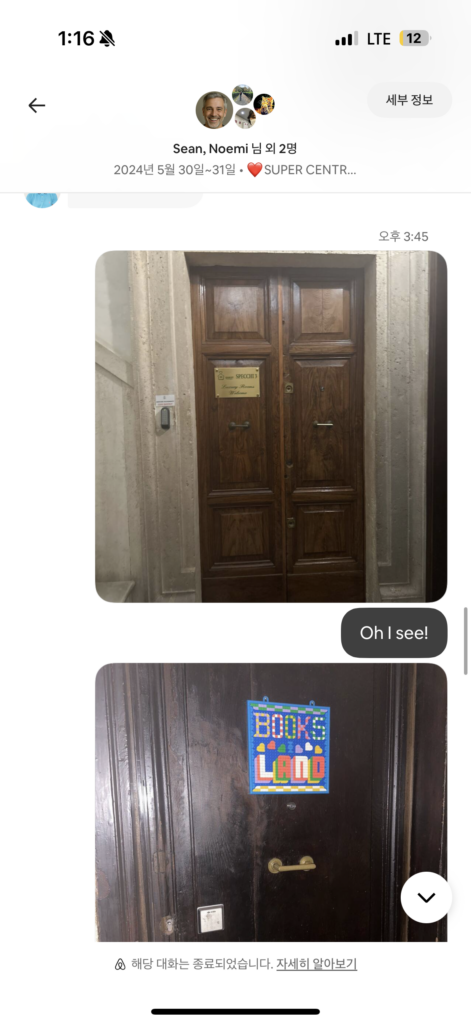
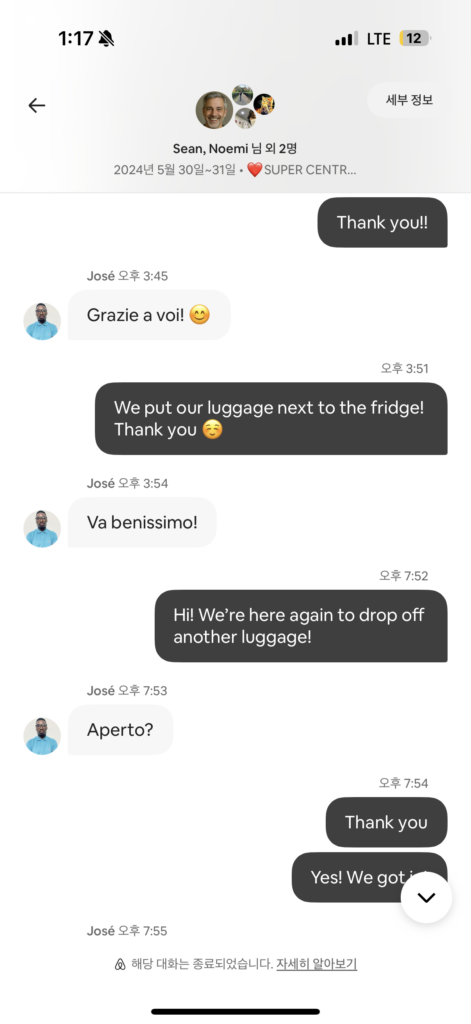
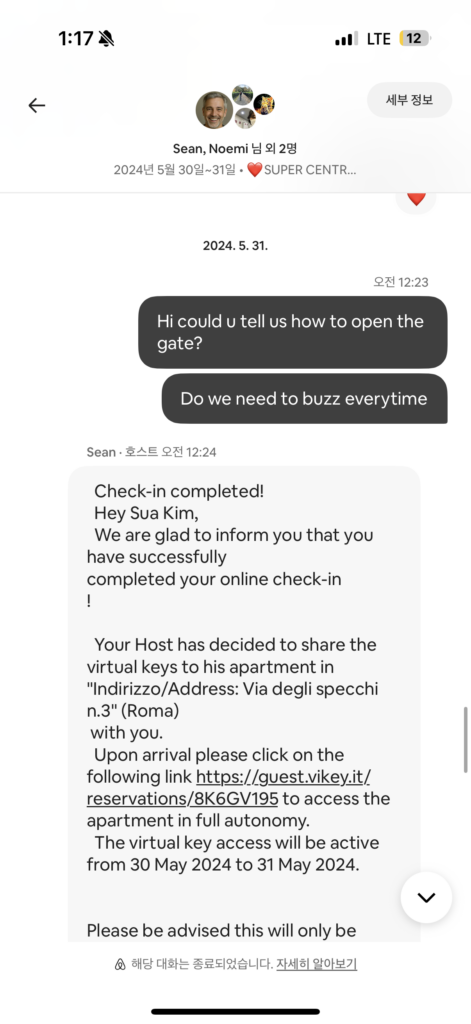
As you can see, if you do not put clear instructions, you have to communicate with guests ALL THE TIME; that is exhausting and time-consuming. Plus, guests do not like it neither.
The Template Structure You Can Steal
Here’s the exact structure I use for every property:
PAGE 1: BRANDED COVER
- Property name/logo
- Simple graphic
- “Manual” or “Guide” in both languages if applicable
PAGES 2-3: LOCATION & ARRIVAL
- Full address
- Map with location marked
- Public transport directions with photos
- Parking instructions (if applicable)
- What building looks like (photo)
PAGE 4: CHECK-IN PROCESS
- Door location/number
- Entry code system (with photos)
- Step-by-step with visuals
- Backup plan: “If this doesn’t work, contact me”
PAGE 5: TIMING
- Check-in time (with boundary language)
- Check-out time (with reason for no flexibility)
PAGE 6: WIFI & CONNECTIVITY
- Network name
- Password
- Location of router
- Backup method (QR code)
- Troubleshooting contact
PAGES 7-8: APPLIANCES & SYSTEMS One page per complex system:
- Heating/cooling (with photos of actual controls)
- TV/entertainment (if not intuitive)
- Kitchen appliances (if unusual)
- Washing machine (only if guests can use it)
PAGE 9: WASTE & CLEANING
- Garbage disposal locations
- Recycling system
- Food waste instructions
- Checkout cleanup expectations
PAGES 10-11: RULES & BOUNDARIES List each rule with:
- What it is (clear, simple language)
- Why it matters (reasoning)
- What happens if violated (consequence)
Common categories:
- Smoking policy
- Noise/quiet hours
- Guest capacity
- Food/drink restrictions
- Property care expectations
PAGE 12: LOCAL RECOMMENDATIONS
- Nearest convenience store
- Grocery store
- Good restaurants (3-5 max)
- Emergency contacts (hospital, police)
PAGE 13: THANK YOU & CONTACT
- Warm closing message
- Your contact information
- Hope they enjoy their stay
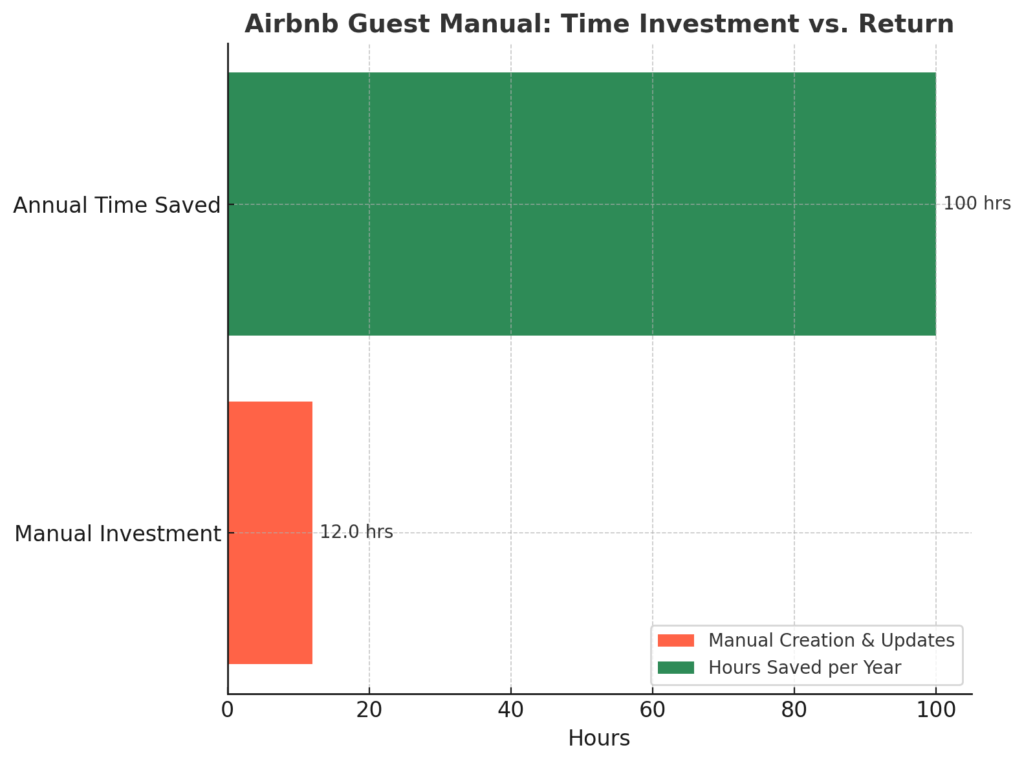
Time Investment vs. Return
Initial Creation:
- First Airbnb manual: 3-4 hours (including photos, design, translation)
- Additional properties: 1-2 hours (reusing template)
Updates:
- Add FAQ as questions arise: 15 minutes each
- Seasonal updates: 30 minutes quarterly
- Print new copies: $3-5 per manual
Return on Investment:
- Hours saved per year not answering repeat questions: 100+
- Bad reviews prevented: Incalculable
- Guest satisfaction increase: Measurable in reviews
- Personal peace of mind: Priceless
According to data from vacation rental management platforms, hosts who provide comprehensive guest information see 23% fewer issues during stays and 31% higher review scores for communication.
The BPD Advantage Nobody Talks About
Here’s what I’ve learned: my “disability” is actually a superpower in hospitality design.
My need for control creates systems that serve guests beautifully.
My fear of ambiguity produces crystal-clear Airbnb manual instructions.
My anxiety about things going wrong prevents problems before they happen.
My attention to detail makes guests feel genuinely cared for.
The guest manual is the perfect example. I didn’t create it to be an amazing host—I created it because my nervous system couldn’t tolerate uncertainty. However, the end result is identical to what the world’s most thoughtful host would create intentionally.
This concept of turning perceived weaknesses into professional strengths is explored in research on neurodiversity in business, showing that different cognitive styles often create innovative solutions.
Related reading: Creating Healing Spaces in Small Apartments: My Complete Guide – how therapeutic design principles apply beyond Airbnb
Your Next Steps
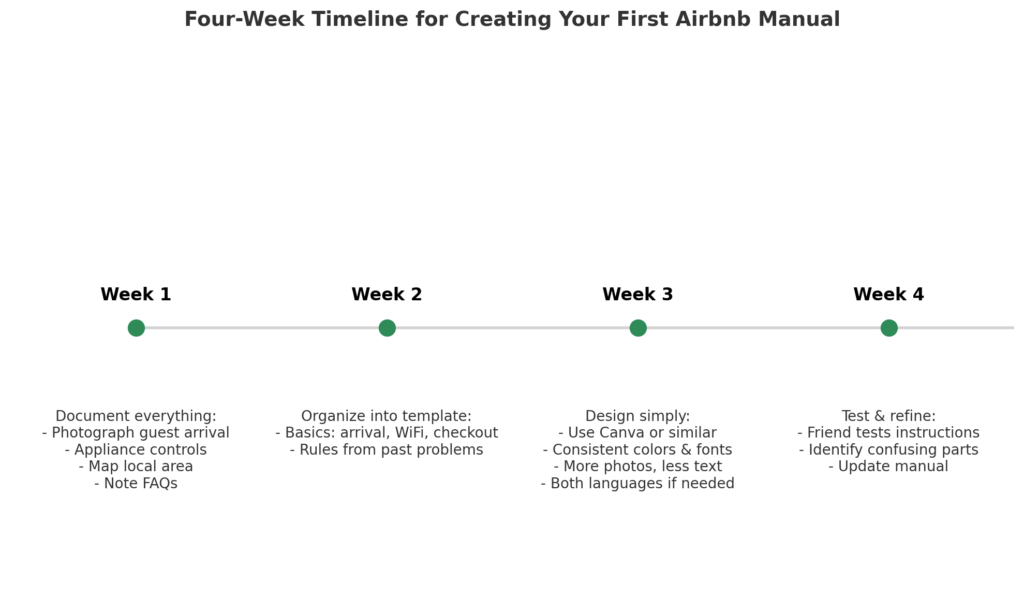
If you’re creating your first Airbnb manual:
Week 1: Document everything
- Photograph every step of guest arrival
- Take photos of all appliance controls
- Map your local area carefully
- Note every question you currently answer
Week 2: Organize into Airbnb manual template
- Use the structure provided below
- Start with basics (arrival, WiFi, checkout)
- Add rules based on problems you’ve actually had
Week 3: Design simply
- Use Canva (free) or similar tool
- Consistent colors and fonts throughout
- More photos, less text
- Both languages if applicable
Week 4: Test and refine
- Give Airbnb manual to friend unfamiliar with your space
- Can they follow all instructions?
- What’s still confusing?
- Update based on feedback
If you already have a manual:
Audit what’s missing:
- Compare to template structure above
- What questions do you still receive?
- What rules exist only in your head?
- What assumptions are you making?
Add visual elements:
- Replace text-only instructions with photos
- Add maps for spatial information
- Label photos with arrows/circles
- Use color to organize sections
Clarify consequences:
- Every rule needs clear outcome
- Frame positively when possible
- Explain reasoning, not just restriction
The Downloadable Airbnb Manual Template
I’ve created a customizable version of my exact Airbnb guest manual structure.
Get it here: [Download the Free Airbnb Manual Template]
What’s included:
- 13-page Google Presentation Template
- Photo placement guides
- Bilingual text structure
- Design specifications
- Update checklist
How to use it:
- Duplicate template in Google Presentation
- Replace placeholder photos with yours
- Fill in your specific information
- Export as PDF
- Print or share digitally (I recommend you to do both)
This Airbnb manual template eliminates the guesswork and provides a professional foundation you can customize for any property.
Common Questions About Airbnb Manuals
“Isn’t 13 pages too much?”
Guests don’t read it all at once—they reference what they need when they need it. Having too much information in your Airbnb manual is better than not enough. Think of it as a reference guide, not a novel.
“My guests don’t read anything anyway”
Some won’t. However, having an Airbnb guest manual eliminates “you never told me” complaints. You can point to the manual for documentation.
“What if I don’t have design skills?”
Use the Airbnb manual template provided. Canva is designed for non-designers. Furthermore, function matters more than beauty.
“Should I offer digital or physical?”
Both. Print one copy for the property. Additionally, send PDF via message after booking. Different guests prefer different formats.
“Do I need to translate everything?”
If you host international guests, yes. Run through Google Translate then have a native speaker verify. Approximate translation beats no translation in your Airbnb manual.
“What if my rules seem too strict?”
Clear boundaries attract better guests. People who complain about rules are usually the ones who want to violate them.
The Manual as Therapy
Creating these manuals became an unexpected form of therapy for managing my BPD. Each section I completed was one less thing to worry about. Each question I answered preemptively was one less potential conflict.
The manual holds boundaries I struggled to hold myself. It answers questions before my anxiety could spiral. It creates the predictability my nervous system desperately needs.
And somehow, in creating the exact experience I needed as a host, I created the exact experience guests needed as travelers.
Your challenges—whatever they are—might be the exact perspective that creates something valuable.
Final Thoughts
The Airbnb guest manual sitting in my properties isn’t just a document. It’s proof that what I thought made me “too much” actually makes me better at what I do.
My need for control isn’t a flaw to overcome—it’s a skill to harness through systematic documentation.
Your version of an Airbnb manual doesn’t need to be as detailed as mine (though it can be). Start with the basics, add as you go, and trust that the effort you put into preventing problems will pay dividends in guest satisfaction and your own peace of mind.
The best investment I made in my Airbnb business wasn’t better furniture or fancier decor. Rather, it was those 6 hours creating the first manual that now protects me from hundreds of hours of anxiety and confusion.
Download the Complete Airbnb Manual Template
Get my exact 13-page structure, customizable for your property.
Read Next:
How Managing BPD Made Me a Better Airbnb Host: My Mental Health Design Journey – the full story of how vulnerability became my competitive advantage


One Comment
Comments are closed.