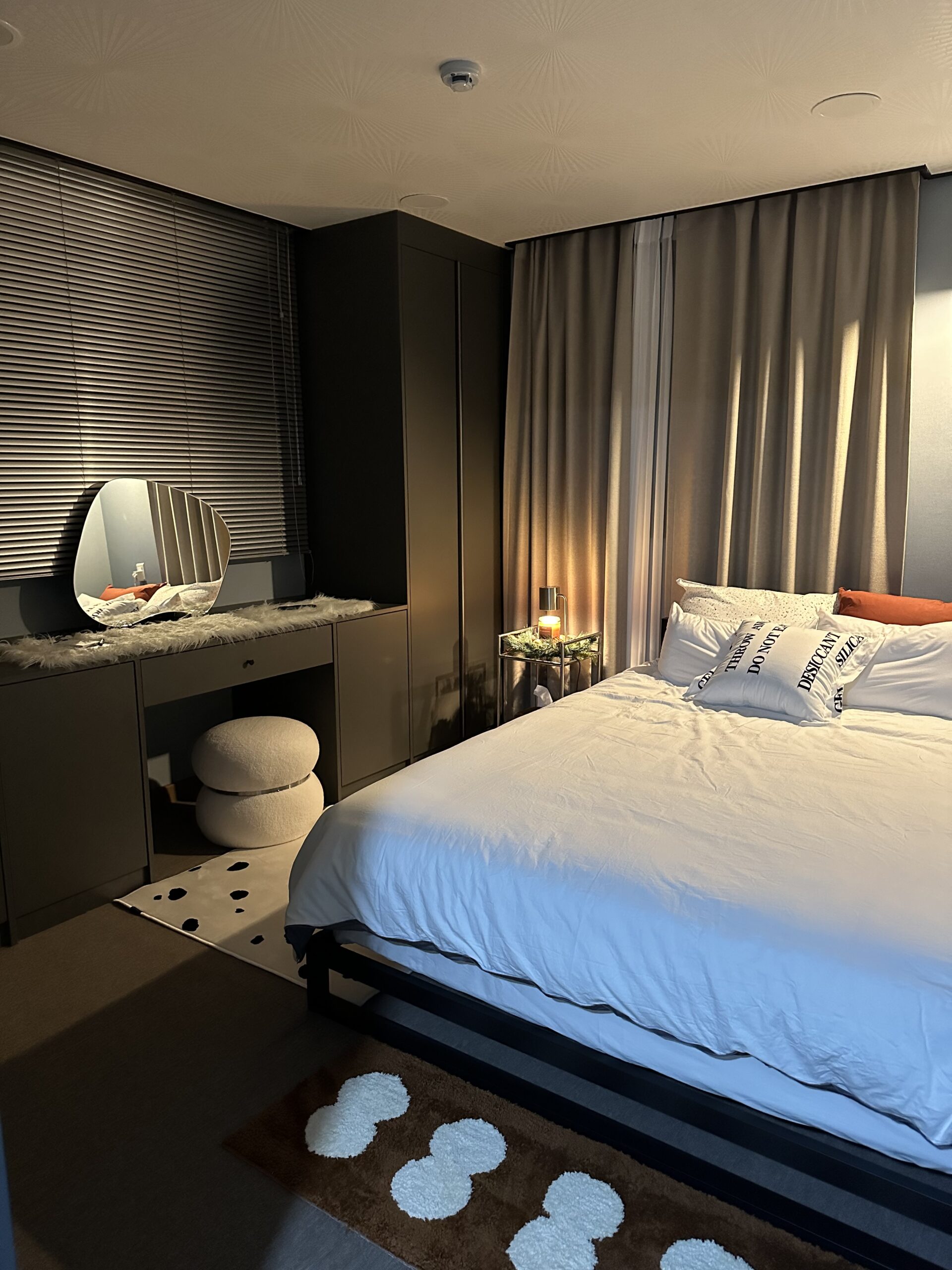
Best Blackout Curtains for Small Bedrooms (2026): What Actually Blocks Light in a Tiny Space

I stayed at a friend’s studio apartment in Seoul and couldn’t sleep past 6 am.
Not because of noise or temperature. Because her blackout curtains stopped 15 centimetres above the floor, and light pooled in from underneath like water finding the lowest point. By 6am, the entire room glowed with reflected morning light bouncing off pale walls.
She’d bought them at a department store. Standard length. Standard width. They covered the window frame exactly. Which is the problem—curtains that cover exactly the window and nothing more don’t actually block light in small rooms where every surface reflects.
I’ve seen this same setup in multiple Airbnbs I’ve stayed in. Short curtains hover above the floor. Narrow panels that barely meet in the middle. Cheap fabric that looks crispy and stiff. My father made this exact mistake—bought budget blackout curtains that were so plasticky they looked actively cheap. He eventually asked me which ones to buy instead.
The pattern is consistent: people buy curtains to fit the window, not the room. Then they wake up at dawn, wondering why “blackout” curtains aren’t working.
Here’s what actually blocks light in a small bedroom—tested across five Airbnb properties and learned from enough curtain failures in other people’s spaces.
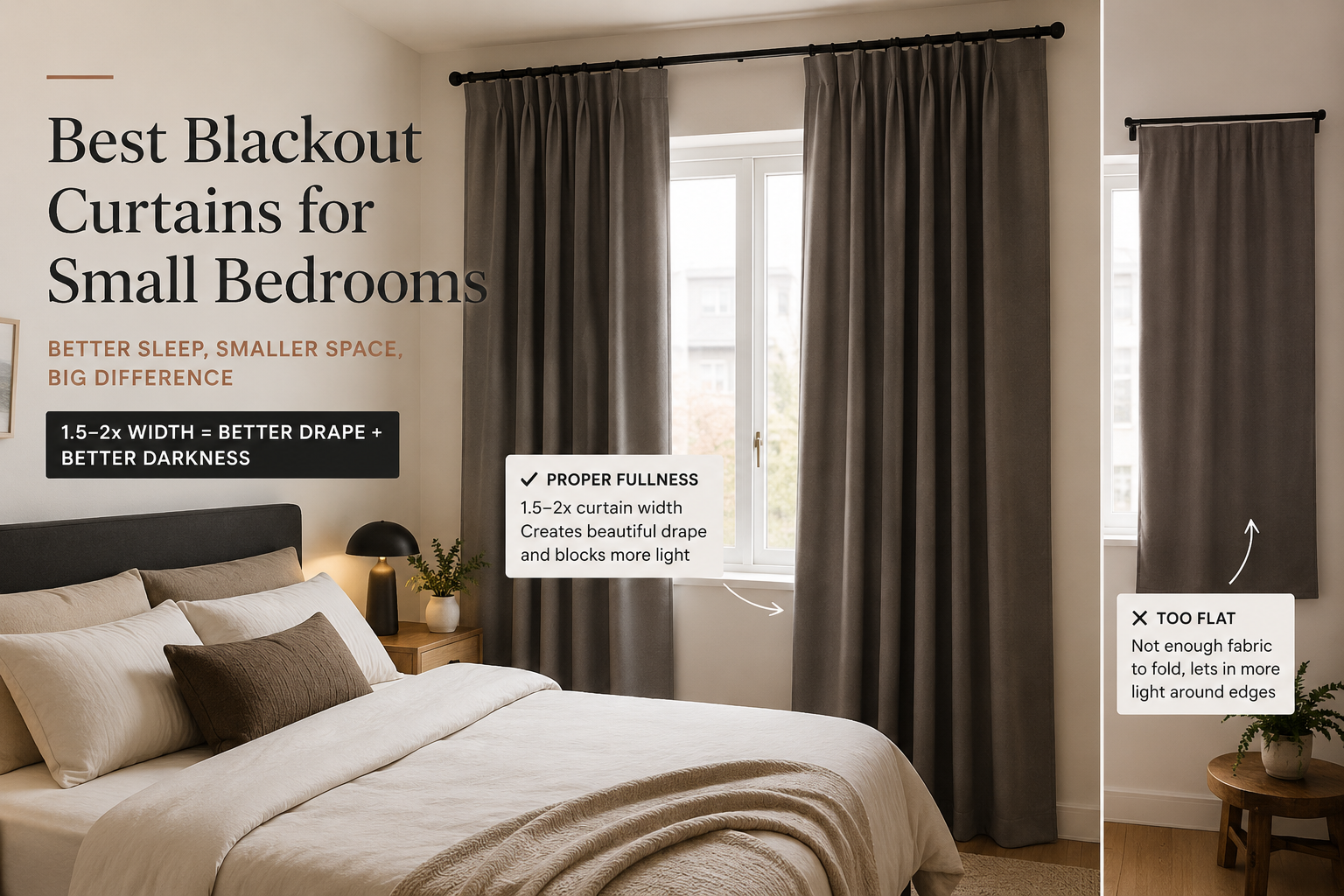
Why Blackout Curtains Matter More in Small Bedrooms
In a large bedroom, a window is a feature. In a small bedroom, a window is half the wall.
More glass means more light intrusion—early morning sun and streetlight glow that disrupts sleep cycles. Light suppresses melatonin production. If you’re managing anxiety, depression, or general difficulty existing, one night of bad sleep doesn’t stay contained to that night.
Blackout curtains work every night without requiring you to remember anything. This is meaningful in a product.
The second reason: privacy. Lower floor flat, window facing another building, room at street level—without proper curtains, you’re visible after dark. Some people don’t mind. Most people, when they think about it, do.
Why Short Curtains Fail (Why I hate them)
Short curtains—the ones that hover between the window and the floor—create two problems:
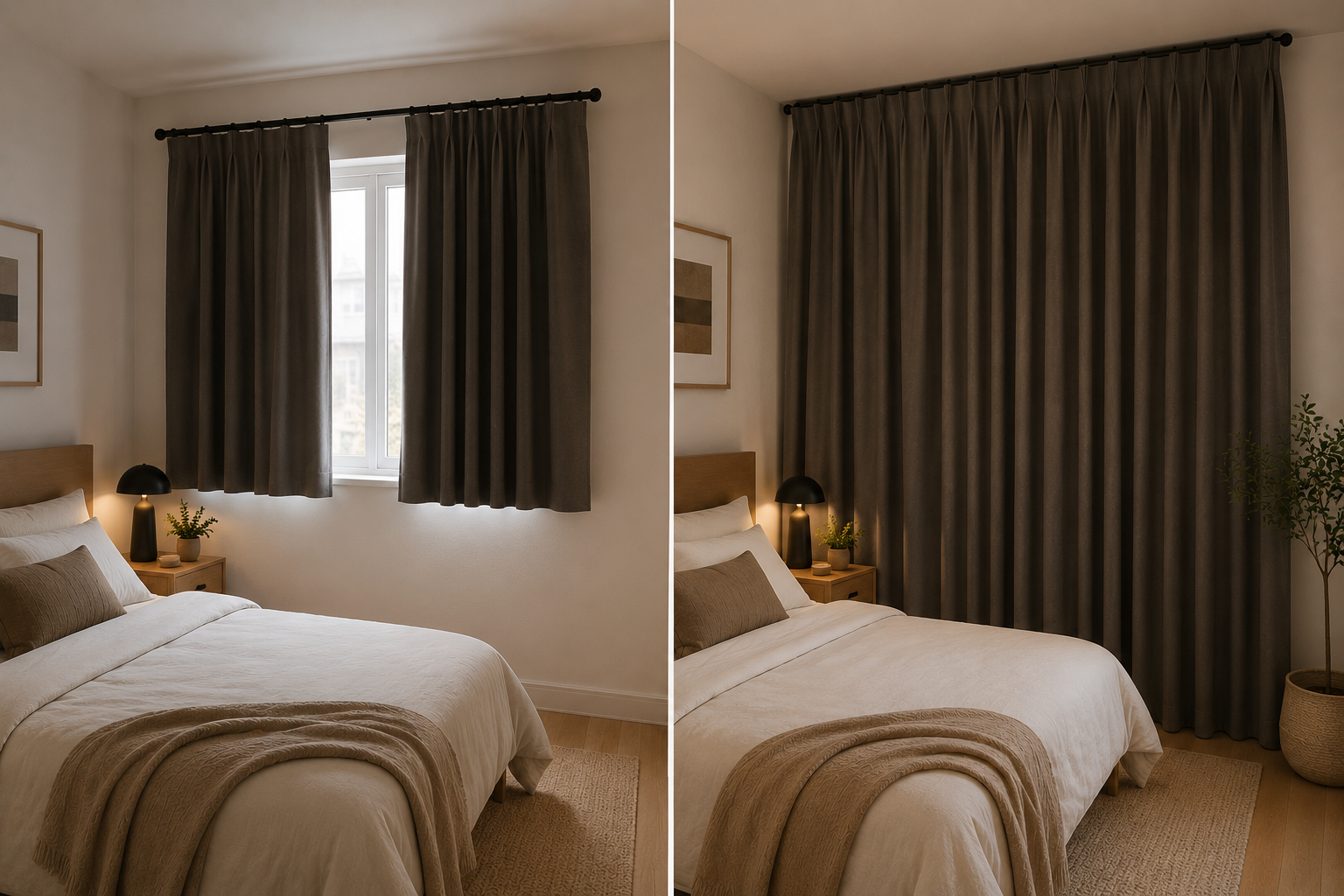
They can make rooms look shorter. Curtains that stop mid-wall often create a horizontal line that cuts perceived ceiling height. Your eye stops at that line instead of travelling to the floor. In small bedrooms with standard 2.4m ceilings, you can’t afford to lose visual height.
They tend to signal incomplete design. That gap between the curtain hem and the floor often reads as “not enough budget” or “temporary solution” rather than an intentional choice. Neither thought improves the room.
Floor-length curtains—or curtains that touch the floor with a slight break—make rooms look taller. The vertical line continues from the ceiling to the floor without interruption. Basic visual mathematics that works in most small bedrooms.
The Whole-Wall Curtain Strategy
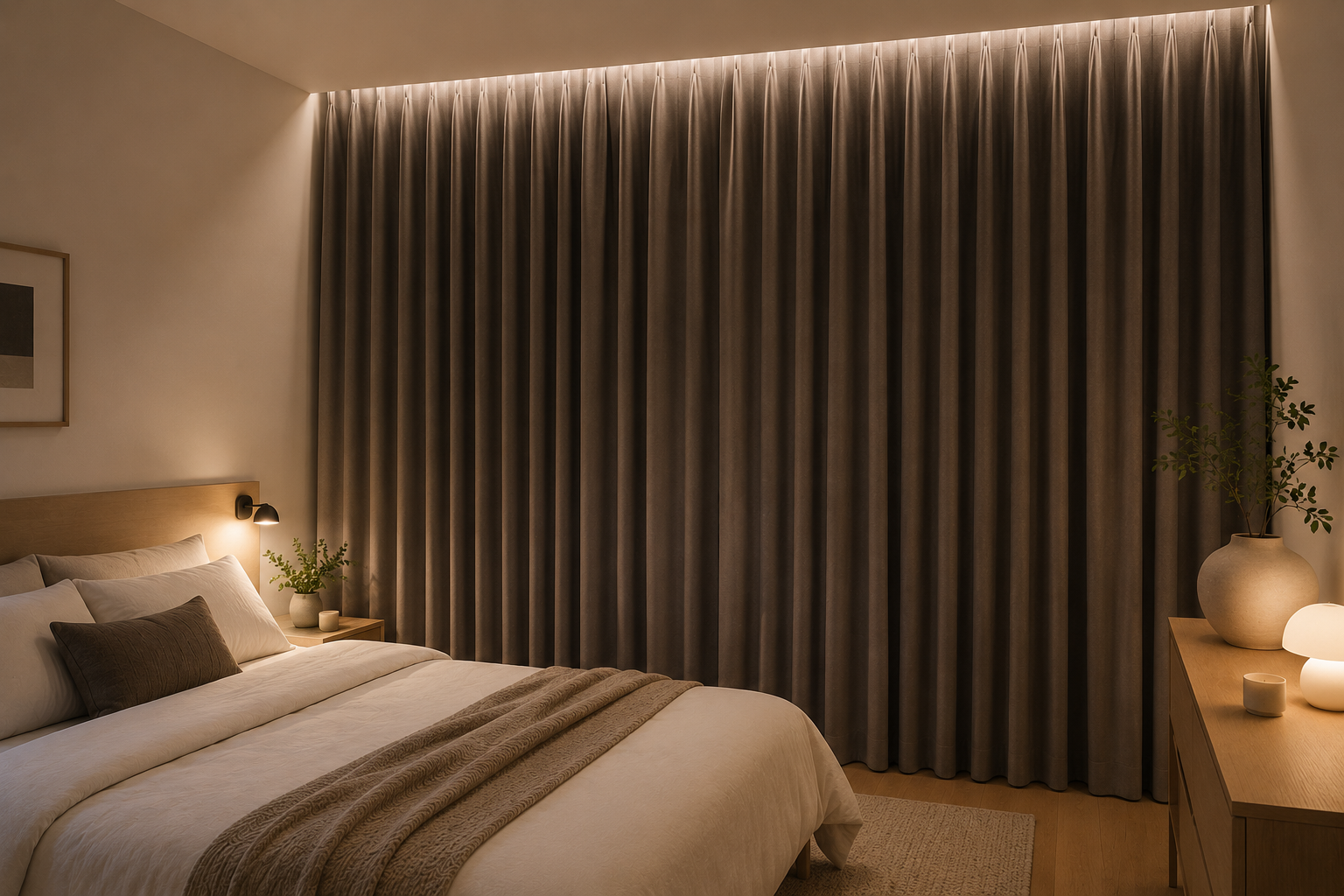
Whenever I buy curtains—whether for half-wall or full-wall windows—I buy something that could cover the entire wall. Floor to ceiling, wall to wall.
Why this works: It creates the illusion that the window is much bigger than it actually is. Like floor-to-ceiling windows in luxury condos. Your brain reads “large window” even when the actual glass is standard apartment issue.
How I do this: Rails instead of rods. Rails mount to the ceiling or very high on the wall and run the entire width. You can extend curtains across an entire wall, not just the window section.
Rods have problems. Sometimes too plastic (looks cheap, bends under weight). Sometimes too antique (ornate finials that compete with the room). Sometimes too weak to support proper blackout curtains, plus the extra width needed for fullness.
Rails solve this—hidden behind the curtain heading, support substantial weight, and allow wall-to-wall coverage.
For renters: Heavy-duty rods mounted high are the compromise. Still go wider than the window, still go to the floor, but accept you can’t do full wall-to-wall without ceiling mounting.
The Double-Layer Solution
Blackout curtains alone can feel heavy—visually and literally. Heavy fabric that blocks all light also creates a bunker feeling in small bedrooms during the daytime.
My solution: Double layers.
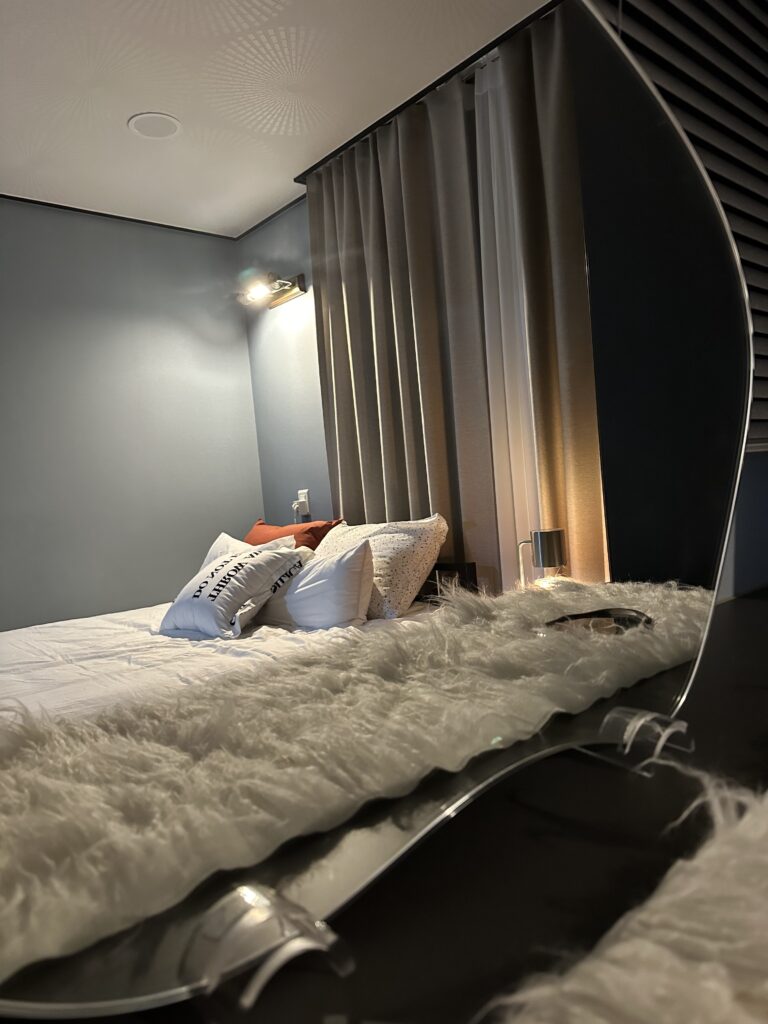
Inner layer: Sheer chiffon or lightweight linen. Filters daytime light, provides privacy whilst letting natural light in.
Outer layer: Blackout curtains. Used only when you need actual darkness—nighttime, afternoon naps, blocking streetlights.
Why this works better:
- Daytime flexibility: Open blackout, keep sheers closed for filtered light and privacy
- Softer aesthetic: The room doesn’t look permanently dark
- Better insulation: Double layers provide more temperature control
- Visual depth: Layered curtains create dimension on otherwise flat walls
I use this system in every bedroom where I control window treatments. Sheers stay closed most days (privacy), blackout closes at night (sleep), and the room feels adaptable.
The Width Rule Everyone Gets Wrong
Buy curtains 1.5x to 2x wider than the area you’re covering.
This is the difference between curtains that look flowy and elegant versus curtains that look stretched and cheap.
The math: Window width 140cm + coverage extending to 200cm = you need a total curtain width of 300-400cm (split across 3-4 panels).
When curtains have 1.5-2x fullness, they drape naturally. When they’re exactly the width of coverage, they pull flat and tight, showing every wrinkle.
In small bedrooms specifically: This fullness creates visual softness that makes rooms feel more expensive. Flat, taut curtains read as budget or temporary. Properly full curtains read as intentional design.
Cost implication: Yes, buying 300-400cm of curtain for 200cm coverage means 3-4 panels instead of 2. The cost increase is real, but necessary—budget curtains in proper fullness look better than expensive curtains pulled flat.
Best Blackout Curtains for Small Bedrooms
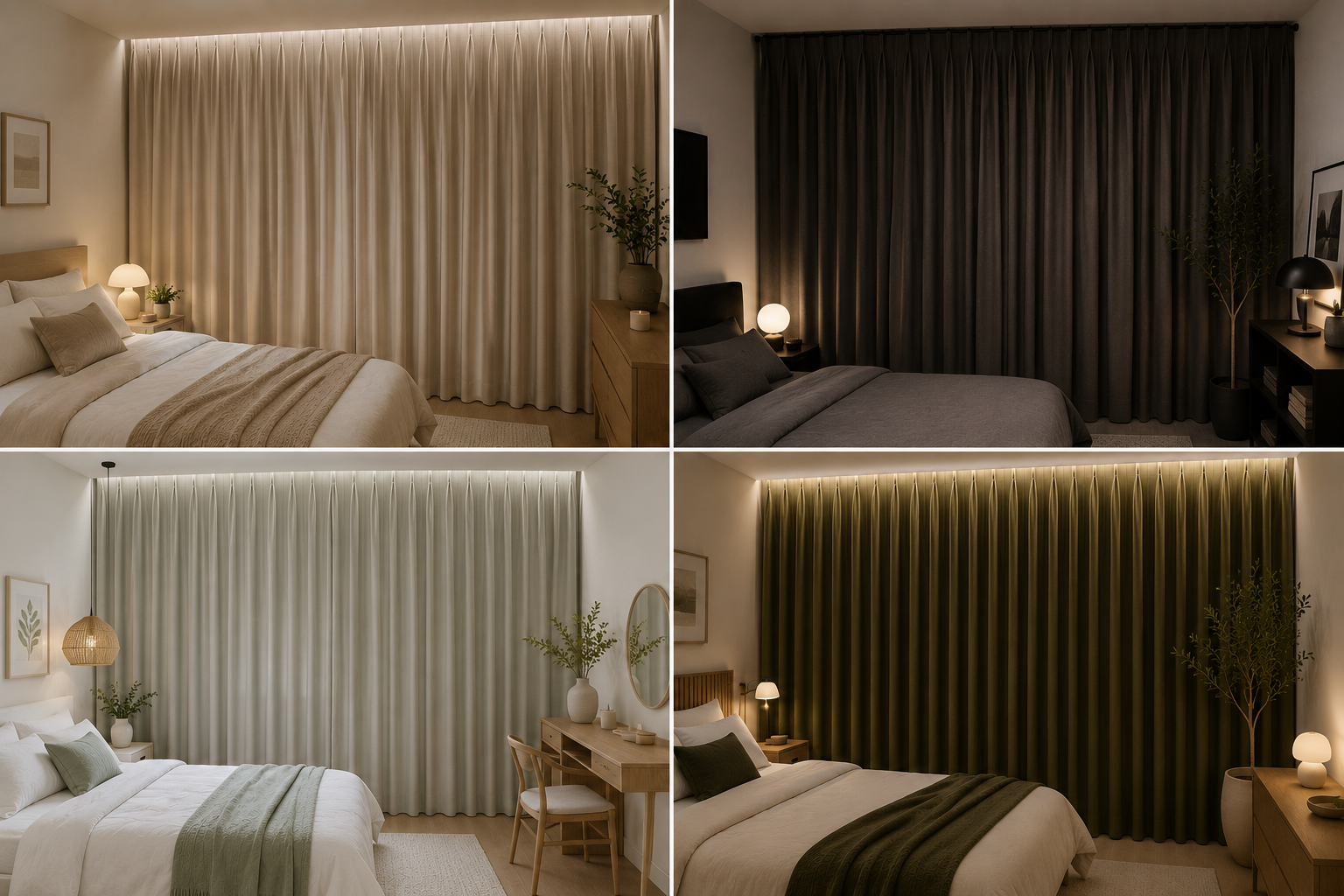
1. Best Overall: Triple Weave Blackout Curtains
Why these work: Triple-weave construction actually blocks light. Available in neutral colours. Hang without excessive wrinkling. Support the double-layer system if you add sheer curtains.
For small bedrooms: Buy 52″ width panels (132cm each). For 140cm window with 200cm wall coverage goal, get 4 panels total = 264cm per side = 2.6x fullness. Perfect drape.
Caveat: Need proper rod or rail support. The weight with proper fullness is substantial.
Best for: Most small bedrooms, most situations.
If you don’t want to overthink this, just get this one. It works.
👉 Look for “triple weave blackout curtains” — I’ll link my exact pick here soon
2. Best Budget: Room Darkening Curtains
Why these work: Block 85-90% of light at significantly lower cost. Good enough if you’re layering with sheers anyway.
For small bedrooms: Still buy 1.5x width minimum. Budget curtains pulled flat look worse than mid-range curtains with proper fullness.
Caveat: Will not achieve complete darkness. Early morning light will filter through.
Best for: Renters, temporary spaces, anyone layering with sheers where complete blackout isn’t critical.
If you’re layering with sheers anyway, don’t overpay — this is enough.
👉 Look for “Room Darkening Curtains” — I’ll link my exact pick here soon
3. Best for Double-Layer Setup: Sheer + Blackout Combination
Why these work: Sold as sets designed to layer. Sheer inner layer and blackout outer layer come in matching colours, same rod pocket sizing, designed to hang together.
For small bedrooms: The easiest way to achieve the double-layer effect without buying two separate sets and hoping they work together.
Caveat: Still need to buy proper width (1.5-2x coverage area). Check measurements carefully.
Best for: Anyone wanting a layered look without experimenting, small bedrooms needing daytime privacy plus nighttime darkness.
If you want the layered look without messing it up, this is the easiest option.
👉 Look for “Sheer + Blackout Combination” — I’ll link my exact pick here soon
4. Best for Rails/Ceiling Mount: Thermaback Blackout Curtains
Why these work: Grommet or rod pocket options that work with ceiling-mounted rails. Thermal backing provides insulation alongside light blocking.
For small bedrooms with rails: Weight distributes evenly across rail systems. Can achieve true wall-to-wall coverage.
Caveat: Heavier than standard blackout due to thermal backing. Requires proper rail/rod installation—not for tension rods.
Best for: Permanent housing where you can install ceiling rails, cold climates.
If you’re installing ceiling rails, don’t cheap out — this setup actually works.
👉 Look for “Thermaback Blackout Curtains” — I’ll link my exact pick here soon
5. Best Aesthetic: Linen-Look Blackout Curtains
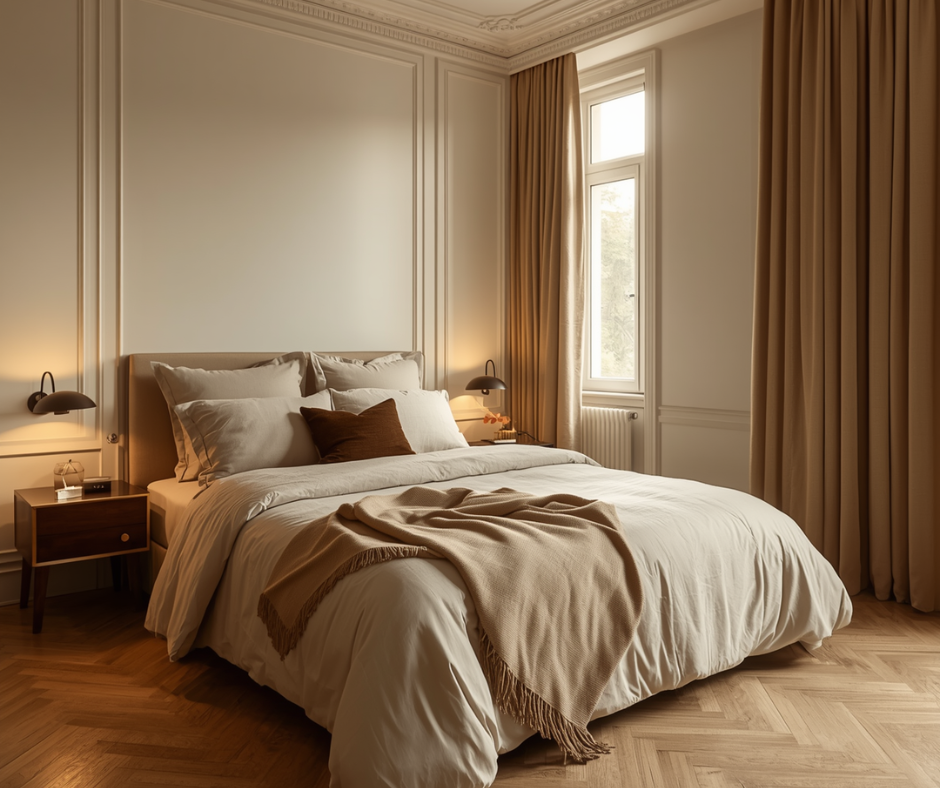
Why these work: Blackout backing behind linen-textured face fabric. Blocks light whilst maintaining the soft, expensive look of linen.
My neutral Airbnb property uses these. They photograph beautifully whilst performing an actual light-blocking function.
For small bedrooms: Linen texture adds visual interest without pattern or colour—perfect for maintaining a calm aesthetic whilst solving the light problem.
Caveat: More expensive ($40-80 more per panel set). Worth it if the room needs to look considered.
Best for: Design-forward spaces, Airbnb properties, anyone who cares how the room photographs.
If you care how your room looks in photos, this is the one.
👉 Look for “Linen-Look Blackout Curtains” — I’ll link my exact pick here soon
How to Install Them (The Critical Parts)
Rails vs. Rods:
Choose rails if you own the property and want wall-to-wall coverage with heavy curtains or double layers.
Choose rods if you’re renting, only need to cover the window plus 15-20cm on each side, or have lighter-weight curtains.
Key measurements:
- Mounting height: As close to the ceiling as possible (makes ceilings look taller, eliminates top light gap)
- Width extension: At least 15-20cm beyond the window frame on each side
- Length: From mounting point to floor, add 2-5cm for a slight break
The width calculation:
- Measure coverage area (window width + extensions)
- Multiply by 1.5 minimum or 2 for ideal drape
- Divide by panel width to determine how many you need
Example: 200cm coverage × 2 = 400cm total needed. With 100cm panels = 4 panels total.
What My Father Learned About Cheap Curtains
My father bought budget blackout curtains. Stiff, plasticky, made crinkling sounds. They blocked light adequately but looked actively cheap.
He eventually asked me which to buy instead.
I sent him mid-range blackout curtains with proper fabric weight and 50% more width than his window. Same price as original purchase plus one additional panel. The difference was immediate—the room looked more expensive, the curtains draped instead of hanging stiffly, and the light blocking improved because extra fullness eliminated edge gaps.
The lesson: Cheap curtains in the correct width beat expensive curtains pulled flat. But genuinely cheap fabric (crispy, plasticky, stiff) cannot be saved by any amount of fullness—buy the best fabric quality you can afford, then buy enough width to make it drape.
Quick Comparison
| Situation | Recommended Option |
|---|---|
| Most small bedrooms | Triple Weave |
| Tight budget | Room Darkening |
| Want double layers | Sheer + Blackout Set |
| Installing ceiling rails | Thermaback |
| Design-forward space | Linen-look blackout |
The Low-Capacity Rule
On days when the decision feels impossible:
Pick cream, warm white, or soft grey. Order 1.5-2x the width you need. Hang them floor-to-ceiling. Move on.
Neutral colours work in almost every small bedroom. If you’ve been researching for more than ten minutes without deciding, you’re in decision fatigue. The neutral option in proper fullness is not settling—it’s the correct answer when cognitive bandwidth is limited.
The curtains you order today block more light than the perfect curtains you’re still researching next month.
What Actually Matters
Blackout curtains in small bedrooms need to:
- Block light (the actual function)
- Make the room look taller (floor-length, ceiling-mounted)
- Create visual softness (1.5-2x width for proper drape)
Everything else—colour, texture, thermal backing, sheer layers—is preference and situation-specific.
Start with these three non-negotiables. The curtains will work every night without requiring you to remember anything. On days when the flat is a disaster and the routine has collapsed and the only thing standing between you and a bad week is whether you sleep—the curtains do their part regardless.
For more on better sleep environments, see my guide on bedroom lighting for better sleep and 5 small bedroom design changes for better sleep and mental health.
Now go measure your windows. Multiply by two. Order curtains that touch the floor.
Suinny Everyday is a participant in the Amazon Services LLC Associates Program, an affiliate advertising program. As an Amazon Associate, I earn from qualifying purchases at no extra cost to you.